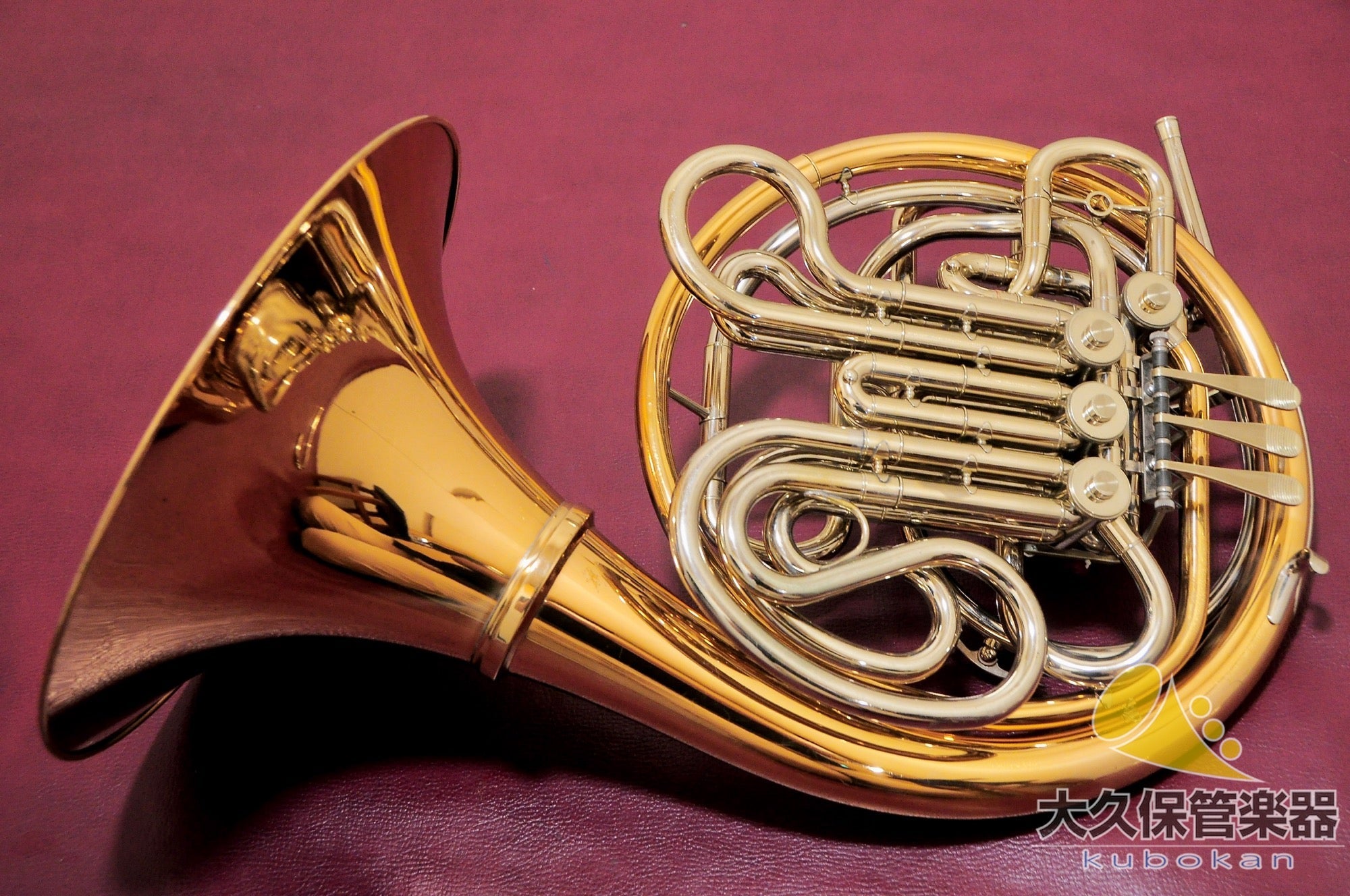
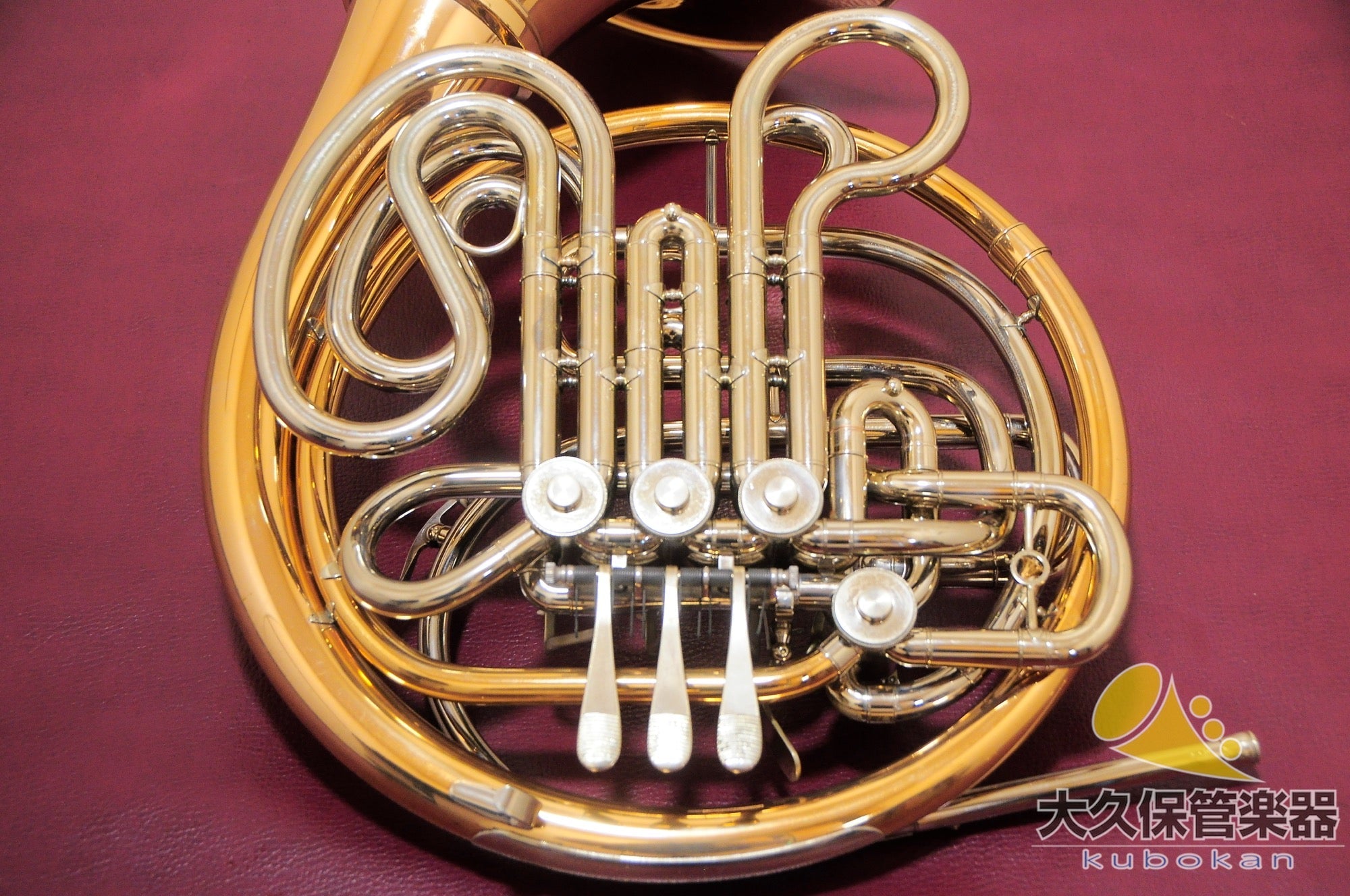
"The ideal of a master musician, crystallized in design and tone."
The Barry Tackwell Model—a masterpiece from the golden age of Holton horns.
[Overview]
Holton French Horn, Barry Tackwell Model. Large-throat bronzedetachable bell (*).Nickel-silver body. Rotary chord action. The No. 4 rotary (F/B♭) is fixed. Two detachable mouthpipes (chamber music type #BT 1, orchestra type #BT 4).Manufactured around 1992. Accessories: Holton square-type hard case (not original; the bag for storing replacement pipes is missing). New retail price at time of sale: 1,260,000 yen
. *Align the arrows stamped on the main body and the bell flare (on the parts without threads), then rotate clockwise 90 degrees to secure (see detailed images).
[Condition]
Minor dents scattered across the bell flare, bell body, and No. 3 rotary slide (F tube) > repaired. Solder failure on the braze (retainer) connecting the back of the bell to the No. 4 rotary bypass tube > re-soldered. Lacquer coating has chipped off on the curves of each slide and the bell inner > (simple lacquer touch-ups applied). The mouthpipe (Chamber Music Type #BT 1) has a rough, uneven surface due to lacquer peeling and corrosion on the reinforcement plate. The rubber gasket between the mouthpipe and bell tube has been replaced with cork. Additionally, there are minor scratches and partial lacquer peeling from normal use. All rotaries have been disassembled and cleaned; all wear parts—including rotary cords (strings), corks, and rubber—have been replaced; and the instrument has been fully serviced.
[Features]
The Holton H104 is a flagship model developed in collaboration with world-renowned virtuoso Barry Tuckwell during the era when the company was most dedicated to French horn production. It remained in production until Tuckwell retired, and its design philosophy was carried forward to its successor, the H105.
It features a unique configuration combining a nickel-silver body with a large-throat bronze bell. The rotary action is precise and responsive, resulting in agile articulation. While possessing a soft texture, the sound’s contours remain well-defined, giving it a distinct presence reminiscent of Tackwell’s soloistic playing style.
The bell connection on this instrument is the later-model screw type, rather than the bayonet type used in the very earliest models. However, since it can be secured simply by aligning the arrows and turning it clockwise approximately 90 degrees, it can be attached and removed more quickly than a standard screw-in type.
Another feature is the interchangeable mouthpipe. As standard equipment at the time of sale, it came with the chamber music-style #BT1 and the orchestral-style #BT4.This instrument comes equipped with both of these mouthpieces. The #BT1 offers a compact playing feel and quick response, with a soloistic character where the sound cuts through clearly even within a soft tone. Switching to the #BT4 creates a broader flow of air, transforming the sound into a more symphonic and rich resonance.
It offers the versatility to shape the instrument’s expression according to the musical context and ensemble configuration, along with a unique sound that reflects the aesthetic sensibilities of master hornists. This historic full double horn embodies the technical expertise of the Holton Horn’s heyday and the ideals of Barry Tuckwell.