


Explanation
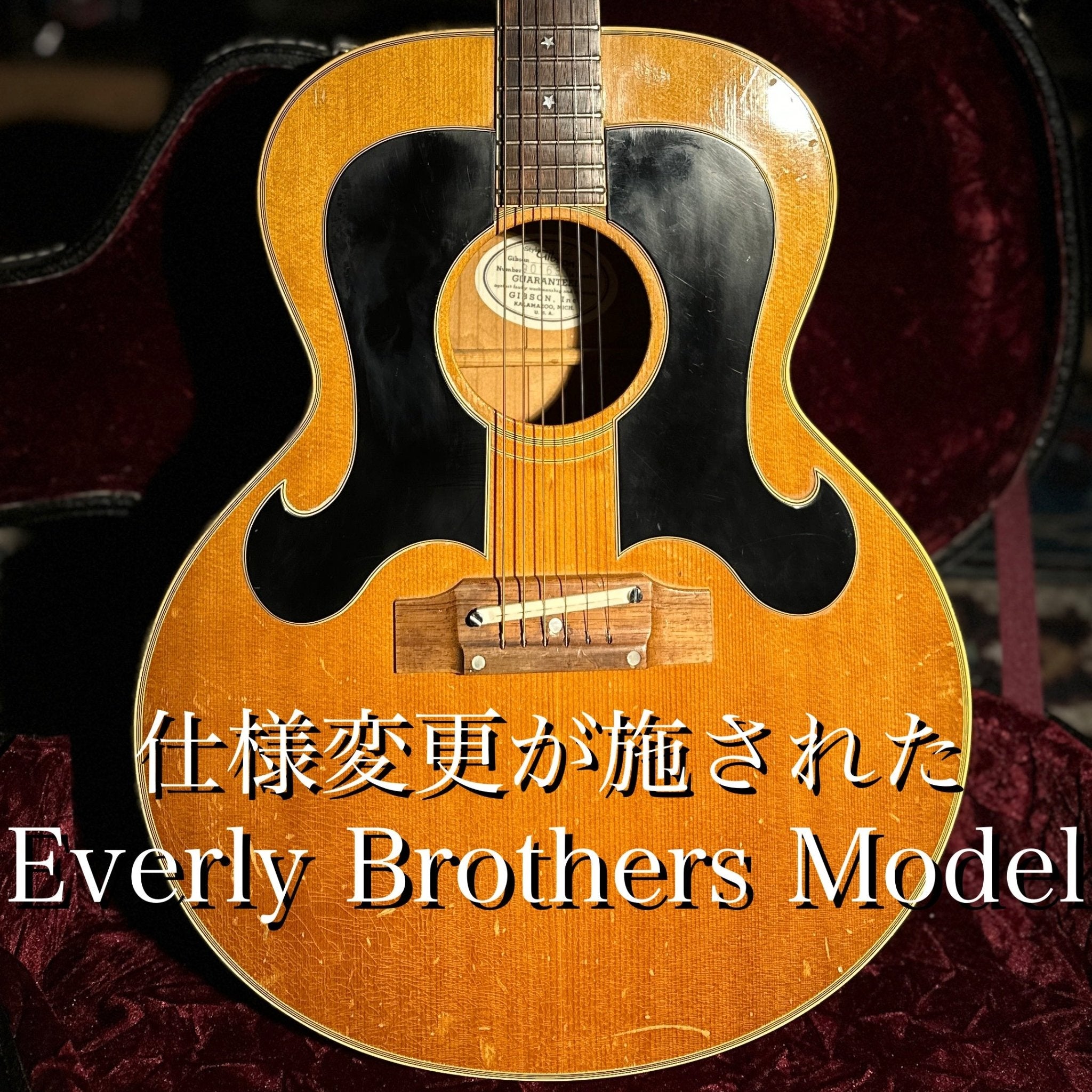
Gibson / 1970 J-180 Everly Brothers
[Try-It-Out Video]
Unraveling the Specification Changes from 1969 to 1970
Compared to the 1969 J-180 Everly Brothers, there are three differences: the finish on the back of the headstock, the volute at the base of the headstock, and the bridge plate.
In terms of color, the 1969 model features a walnut finish, while the 1970 model is finished in black.
In fact, since some 1969 models also have the back of the headstock painted black, it is clear that the specifications changed between 1969 and 1970.

Regarding the base of the headstock, while the 1969 model features a flat surface that connects directly to the neck, this 1970 model has a volute—a raised curve—at the base.
Similar to the paint on the back of the headstock, some 1969 models also feature this volute, further confirming that the specifications for the back of the headstock changed between 1969 and 1970.

The bridge plate also differs: the 1969 model features a maple bridge plate secured by only two bolts for the adjustable saddle, whereas the 1970 model is secured by a total of five bolts—the two for the adjustable saddle plus three additional bolts.
Based on this, we believe the specification was changed to increase the strength of the bridge’s mounting.

[Comment by Hoshino]

It’s interesting to see specification changes even within the same Everly Brothers model—it really captures the spirit of the Gibson era.
Despite its 16-inch size, this guitar has a rich, full-bodied tone that’s a pleasure to play. The differences in the
bridge plate specifications may also contribute to the variations in tone.
[Specs/Included Case]
TOP: Spruce
BACK/SIDES: Maple
FINGERBOARD/BRIDGE: Rosewood
NECK: Mahogany/Mahogany/Mahogany
NUT WIDTH: 40mm
SCALE: 626mm
CASE: Hard Shell Case
[Repair/Modification History / Replaced Parts / Cosmetic Condition, etc.]
*Please note that as this is a used/vintage item, the information provided is based on our inspection and is limited to what we were able to determine.
We appreciate your understanding.
- While there are chips and dents on the upper right corner of the headstock, as well as playwear and scuffs from regular use, this instrument exudes the unique character of a vintage piece.
- A strap pin has been added to the neck heel. - There is an output jack on the lower right side of the
body; however, since it is not wired, it is a dummy jack.
[Playing Condition]
- There is no muffled sound or buzzing, and the instrument plays well.
- String action at the 12th fret: 2.4 mm on the 6th string side, 2.0 mm
on the 1st string side. - String action can be adjusted up or down using the adjustable saddle.
[Peace of Mind Warranty: 6 Months]
[Mail-Order Assurance Service]
Since we cannot offer customers the opportunity to try out the instrument when purchasing by mail order, we provide a 6-day trial period after the product arrives. Please take your time to thoroughly test the product
at home; if you are not satisfied, we will refund the purchase price.
*The customer is responsible for round-trip shipping costs.
Scheduled for shipment
Payment & Security
Your payment information is processed securely. We do not store your credit card details or access your credit card information.
Warranty Information for Used Products
For detailed warranty terms, please see here:
Electric Guitars/Electric Basses/Effectors/Amplifiers (Tuning Warranty: Up to 5 years)
If your instrument malfunctions or stops producing sound after purchase, we will repair it free of charge. The warranty period varies by product.
Acoustic Guitars (Peace of Mind Warranty: Up to 6 months)
For 1 month or 6 months after purchase, we will repair any defects resulting from normal use free of charge.
Wind Instruments (Up to 1 Year)
Upon arrival, we clean the interior of the instrument, replace consumables as needed, and perform any necessary repairs and maintenance. If the instrument malfunctions or stops producing sound due to normal use, we will repair it free of charge.
◯ There is no warranty on junk items.