


Explanation
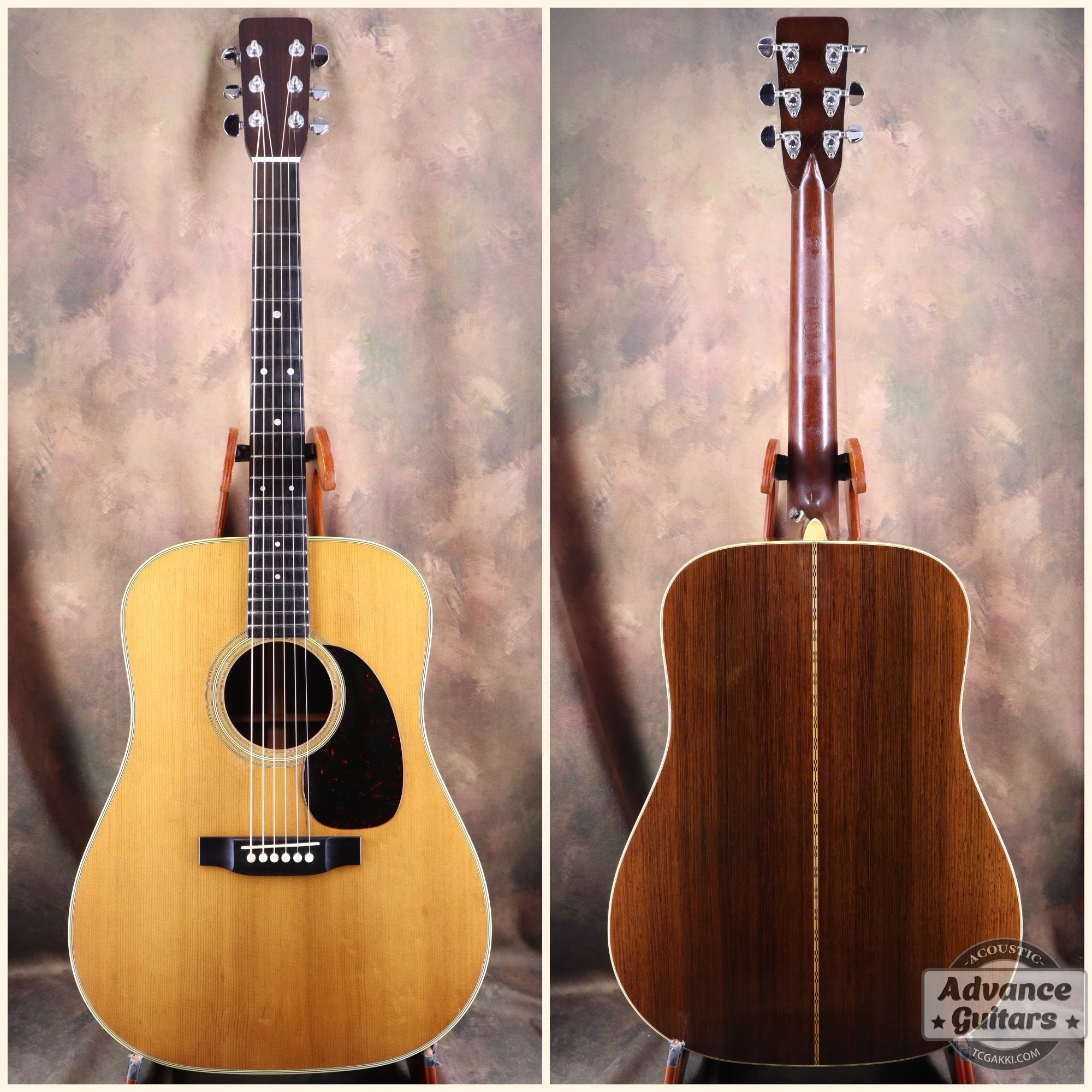
Martin / 1966 D-28 Employee
[Demo Video]
“A highly rare model—the only one of its kind in the world”
“Employee” refers to a model crafted by a Martin employee for their own personal use, just as the name suggests.
Since the Employee model reflects the luthier’s personal preferences, it features unique specifications not found in standard models. I
also believe the luthier likely selected the wood specifically for this instrument.
The “D-28” engraved on the neck block suggests that this instrument was crafted with the D-28 as a model.
Although there is no serial number engraved, the wood used indicates that it is a 1960s-era instrument.

Furthermore, when looking through the soundhole to glimpse the center back bracing, one typically sees a brand mark reading “C.F. Martin & Co. NAZAREETH PA, MADE IN USA.” However, since this instrument lacks such a mark, I wondered if that step was omitted in the manufacturing process, and whether the time and effort saved was instead devoted to refining the assembly of this instrument.
—Brazilian rosewood with a beautiful straight grain


Brazilian rosewood, with its eye-catching fine-grained striped pattern, is used for the sides and back. The fact that the
sides also feature this beautiful, fine-grained Brazilian rosewood suggests that high-quality wood was carefully selected. The
binding is wrapped with 3P celluloid.
—Center Strip

The center strip adorning the center of the Brazilian rosewood back features what is commonly known as the “checkerboard” pattern.
This pattern was adopted in 1947, replacing the previous zigzag design.
— Spruce That Has Taken on an Amber Hue

The top is made of spruce, with 6-ply celluloid binding; the rosette surrounding the soundhole features a three-ring design, identical to that of the traditional D-28.
Additionally, since the binding material was changed from ivoroid to Voltalon in 1966, and this instrument also features Voltalon binding, we estimate it to be a 1966 model.
—Tortoiseshell-Pattern Pickguard Preserved in Its Original State

Tortoiseshell-patterned pickguards have been standard equipment since 1934, when the 14-fret D-28 was introduced, but their shape and coloration have evolved over the years.
Until around the 1940s, the tail end of the pickguard formed a gentle arc, whereas by the 1950s, it had changed to a shape that was somewhat flatter.
A dark tortoiseshell pattern like the one on this instrument began to appear on models from the 1960s onward.
—Jet-Black Ebony and Dot Inlays

The fingerboard is made of ebony and features mother-of-pearl dot position marks, but the 7th-fret position mark deserves special attention.
While it is standard for the D-28 to have two dots at this fret, the key distinction lies in their size.
Until 1945, smaller dot position marks were used, but starting in 1946, they were replaced with larger ones—a specification that would become the standard for subsequent D-28 models.
—The Bridge: A Clue to Dating the Instrument

The bridge, made of ebony like the fingerboard, is fitted with a short saddle.
Saddles were long until 1964, so based solely on the 6-ply binding and the checkered back center strip,
it’s impossible to determine the exact year because long saddles were still in use during that period. Since the short saddle used on this instrument was first adopted in 1965, we can infer that it was built in 1965 or later.
—Thick Neck Shape

I compared the grip of this mahogany neck to those of D-28s from the early and late 1960s. While those models featured a relatively thin V-shape (with individual variations), this instrument features a thick, soft V-shape.
It’s likely that the luthier preferred a thicker shape and incorporated it into the design.
—Wide Headstock with Rounded Corners

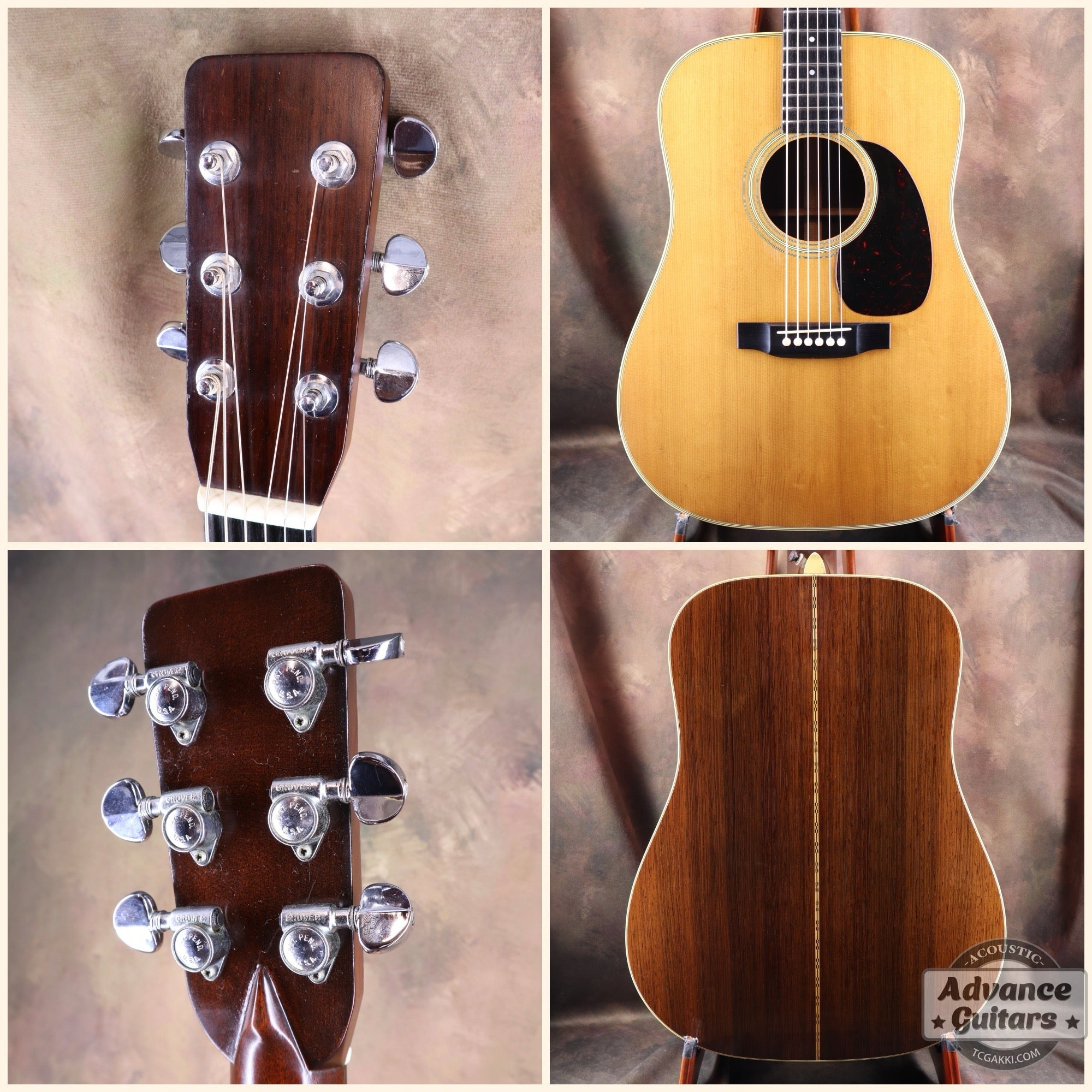
The headstock, made of Brazilian rosewood veneer, does not feature a C.F. Martin decal.
This unique specification raises the question of whether it was intentional on the builder’s part.
—Tuning machines with “PAT” engraving

Starting in 1958, the specification changed from Kluson shield-back tuners to Grover Rotomatic pegs.
A characteristic feature of models from the late 1960s, such as this one, is that the washers are a size larger.

[Specs/Included Case]
TOP: Spruce
BACK/SIDES: Brazilian Rosewood
FINGERBOARD/BRIDGE: Ebony
NECK: Mahogany
NUT WIDTH: 43mm
SCALE: 646mm
CASE: Non-original hard shell case
[Repair/Modification History / Replaced Parts / Cosmetic Condition, etc.]
*Please note that as this is a used/vintage item,
the information provided is based on our store’s inspection and is limited to what we could determine. - The condition is consistent with its age, featuring
scratches, dents, and scuff marks.
- The top has been over-lacquered.
- There is a repaired crack on the lower right of the headstock (reinforced with a patch)
. - There is peeling celluloid on the left waist of the body back.
- There is a crack repair on the back of the headstock, extending from the right volute to the top of the 6th string peg.
- The back of the headstock has been refinished as part of the crack reinforcement.
- There is refinishing on the upper part of the center strip on the back of the body.
- The back of the neck shows paint sagging due to lacquer softening.
- There are signs that the neck has been reset.
- The nut and bridge pins have been replaced with ivory.
[Playing Condition]
- String action at the 12th fret: 2.4 mm on the 6th string side, 2.1 mm on the 1st string side -
Saddle projection: approx. 1.0 mm - Although there is little
saddle material remaining, the instrument plays comfortably.
*Consignment
[Warranty Information]
As this is a consignment item, it does not come with our store’s warranty.
Of course, after purchase, we are happy to discuss adjustments, repairs, etc. (for a fee) upon request.
Please note that this item is not eligible for our mail-order trial service. (No returns accepted.)
Scheduled for shipment
Payment & Security
Your payment information is processed securely. We do not store your credit card details or access your credit card information.
Warranty for Used Products
Please see here for detailed warranty terms:
Electric Guitars/Electric Basses/Effectors/Amplifiers (Tuning Warranty: Up to 5 years)
If your instrument malfunctions or stops producing sound after purchase, we will repair it free of charge. The warranty period varies by product.
Acoustic Guitars (Peace of Mind Warranty: Up to 6 months)
For 1 month or 6 months after purchase, we will repair any defects resulting from normal use free of charge.
Wind Instruments (Up to 1 Year)
Upon arrival, we clean the interior of the instrument, replace consumables as needed, and perform any necessary repairs and maintenance. If the instrument malfunctions or stops producing sound during normal use, we will repair it free of charge.
◯ There is no warranty on junk items.