
Hello, this is Mochizuki from Advance Guitars.
We’ve entered the rainy season, and we’ve been having a string of damp days.
Before I know it, the humidity in my room can sometimes exceed 70%.
To keep my instruments in good condition, I run a dehumidifier almost 24 hours a day at home.
I’m especially careful about managing the humidity in the room where my instruments are kept during this time of year.
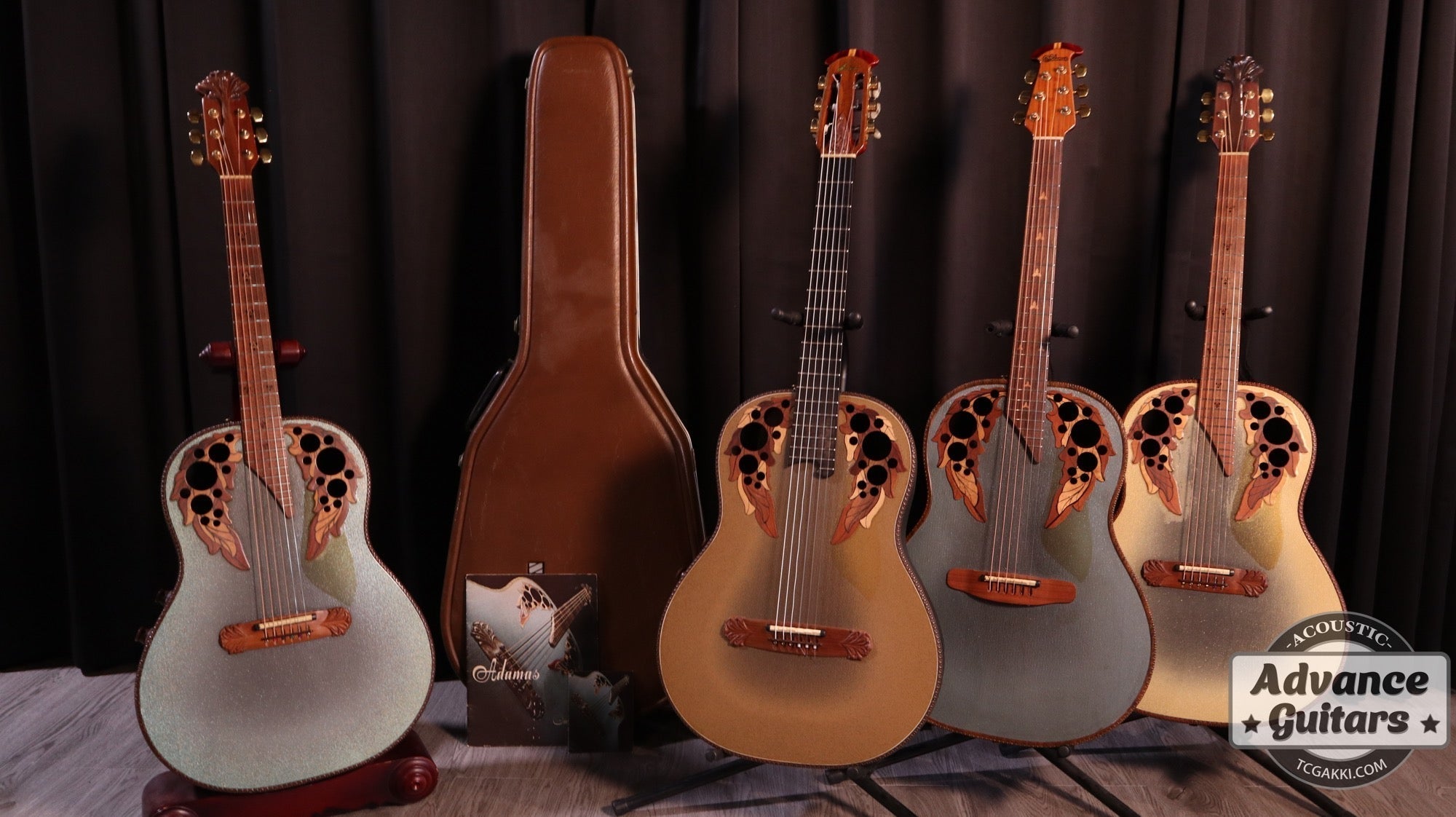
Amid all this, I’ve recently been taking another deep dive into Ovation’s flagship model, the “Adamas.”
That’s because the “Adamas column article” I’ve been planning for some time has finally been published.
In this column, I’ve compiled information from Kaman’s history book—which I studied extensively—along with actual measurements taken on the instruments in our store and the results of my tests, all presented as accurately and readably as possible.
A common topic of discussion is the claim that “the early Adamas models sound better.”
There’s also a theory circulating in some circles that “the top of the early models was thinner than it is today,” so I decided to re-examine this, including taking actual measurements.
Recently, I’ve had the opportunity to encounter instruments truly worthy of being called “legends,” such as the 1944 D-18 once owned by Peter Fonda and the one-of-a-kind Martin “Train.”
Each and every guitar has its own story.
I sincerely look forward to continuing to introduce these guitars to you.
I would be delighted if, through this column, even a few more people could discover the charm of Ovation and Adamas.
Whether you’re a player, an instrument enthusiast, or a retailer, this content is well worth reading.
Please be sure to check out this column whenever you have a moment.
▶️ Click here for the “Adamas Column”
Until next time—I look forward to seeing you in-store.