
This is Nakamura from Kubokan!
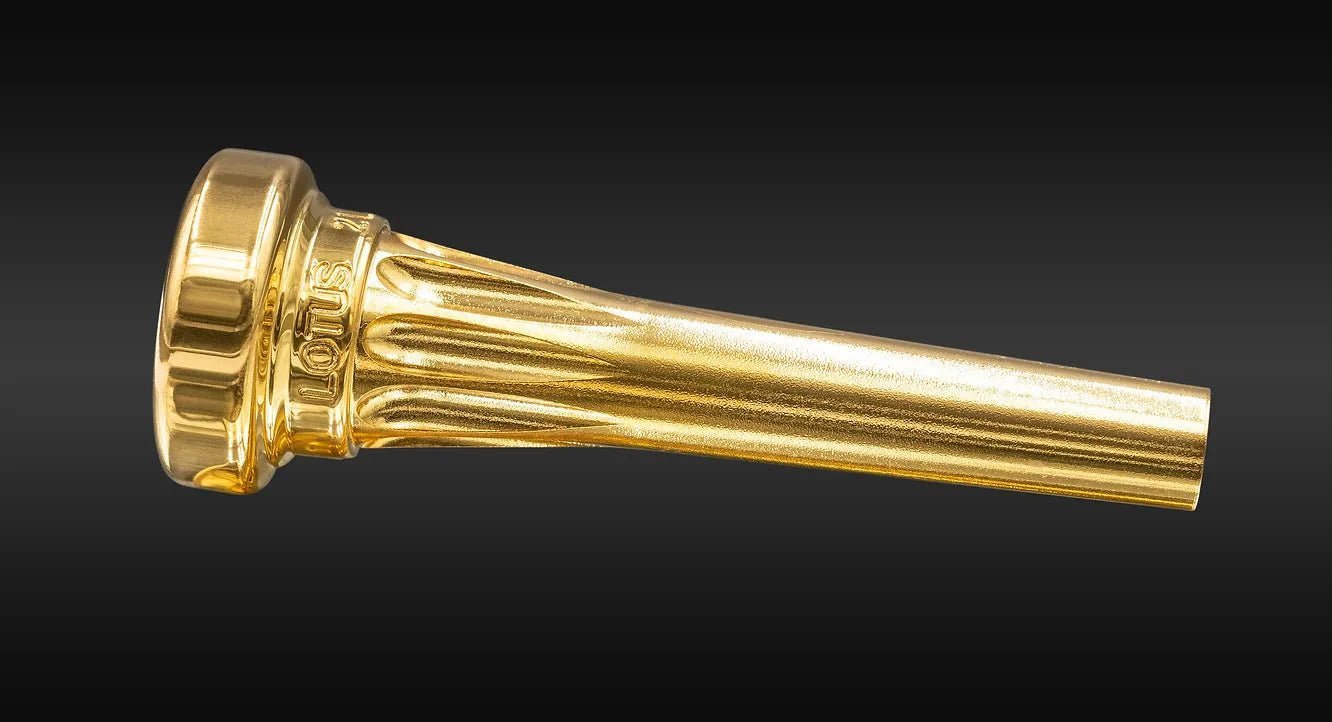
The third-generation Lotus mouthpiece was released in Japan on Saturday, August 5, 2023.
Click here for the official website
Everyone keeps saying “third generation, third generation,” but what’s actually changed…? Isn’t it just that the price went up…?
No, no—that’s not the case at all!
Let’s dive into the secrets behind it.
If you’d rather buy it now than wait to find out the secret, click here
Evolution #1
The gold exterior is the easiest way to tell them apart. Actually, it’s not just gold plating—we’ve used “PVD coating.” While this term might be unfamiliar in the world of wind instruments, it’s a coating method commonly used in jewelry and mold making. It’s by no means special and can be treated just like standard plating. By using PVD coating, we’ve achieved a finish that’s “thin and hard.” It resists scratches, maintains its beauty, and allows the mouthpiece’s characteristics to be conveyed more directly to the player.
Evolution ②
We have revised the throat size and rim shape. We have discontinued the HC Series (High Compression, throat-reduced models) introduced in 2022 and carefully selected the throat size that best suits each model.
XL: No changes
XL2: The throat has become slightly tighter.
L: The throat has become tighter. (Equivalent to the previous HC series)
L2: The throat has become slightly tighter.
M: No changes
M2: The throat has been made slightly tighter. Additionally, a new rim shape has been adopted.
S: The throat has been made tighter (equivalent to the previous HC series). Additionally, a new rim shape has been adopted.
XS: A new rim shape has been adopted.
XS2: New model added
FL: No changes
FLs: No changes
The rim shape features a slightly wider “Marathon Rim” with a shallower cup than the M2 as standard equipment. It offers excellent endurance and ensures a comfortable playing experience.
Evolution ③
The lineup of smaller cups has been expanded. Rim sizes 9 and 11 (equivalent to Bach 10-1/2 to 12), which are smaller than rim sizes 1, 2, 3, and 7, have been officially released, and some models are now also available in L and M cup sizes.
Please see the image below for the production size chart.

● Impressions from Staff Member Nakamura
Based on the features outlined in the official announcement above, I feel that overall, the sound is slightly more focused and has a clearer tonal contour compared to the second generation.
One of the Lotus’s defining features is that it is shorter than a typical mouthpiece, but it seems they’ve managed to retain the benefits this provides—such as pitch, projection, and sound spread—while ensuring a playing feel that’s remarkably natural.
The PVD coating makes the shank particularly resistant to scratches and discoloration. The color is slightly darker than that of standard plating.
Even models labeled “no specification changes” have seen improvements in playing feel. *Personally, I find there’s less of a transition when switching between instruments, and it feels much easier to play! I was also surprised by how transitions from mid to high notes seem to happen “automatically”—without needing to consciously shift my playing style.
Depending on the model, some players might be concerned that the inner bite (inside) of the rim is quite pronounced.
Additionally, compared to the second generation, the entire instrument now features a satin finish. A slight satin finish has also been intentionally left on the rim. It’s not rough enough to be noticeable to the touch, but this may come down to personal preference.
● Upcoming Updates
・We are currently developing the XL3 model, which has a slightly larger throat size than the XL2.
Several players, including Adam Rapa and Brandon Ridenour, are using the XL3 cup.
・We are currently developing a series called “TurboWood,” featuring a wooden upper half.
Designed to withstand harsh outdoor conditions while offering a softer tone and the ability to produce a louder sound with less air pressure, this series stands apart from conventional resin-based mouthpieces in terms of quality. We plan to stock only select models in Japan, though the timing has not yet been determined.
・We are currently producing mouthpieces for short cornets and piccolo trumpets (cornet shank).
Even with deeper cups designed for British brass instruments, they offer proper pitch and access to the high register. Cups designed for piccolos with cornet shanks—such as the “Silky”—provide excellent projection and a stable, well-balanced sound from the mid to high registers. Both are sure to be of outstanding quality. They are scheduled to arrive in Japan around this winter.
Lotus Trumpets continue to evolve. We look forward to seeing what they’ll do next.
We post the latest updates and stock arrivals first on our Twitter account (link), so be sure to check it out.
If you’d like to experience the magic for yourself, you can purchase them here
Past videos related to Lotus are all fascinating as well. Be sure to check them out.
・In the fall of 2022, Adam Rapa himself visited Japan and gave a demonstration. This was a performance at Miki Gakki in Osaka.
・Here’s a short video of Brandon Ridenour performing when he happened to visit our store in the summer of 2023. He played the Lotus Trumpet SOLO model—specifically, his own 2XL3 MR (Marathon Rim, featuring a slightly wider rim shape).
Here’s a glimpse from the other day when Brandon Ridenour (BRANDON RIDENOUR) played the Lotus SOLO model in our store. He used a third-generation Lotus mouthpiece that he brought with him.
— 0-minute walk from JR Shin-Okubo Station 👣😉 Wind Instrument Specialty Store “Kubokan” (@okubokangakki) August 5, 2023
The piece is Debussy’s “La Fille aux Cheveux de Lin.”
You can really hear the warm tone of the SOLO model. pic.twitter.com/PYJfLjkMcU
・We also feature the Lotus on our store’s YouTube channel.
Nakamura