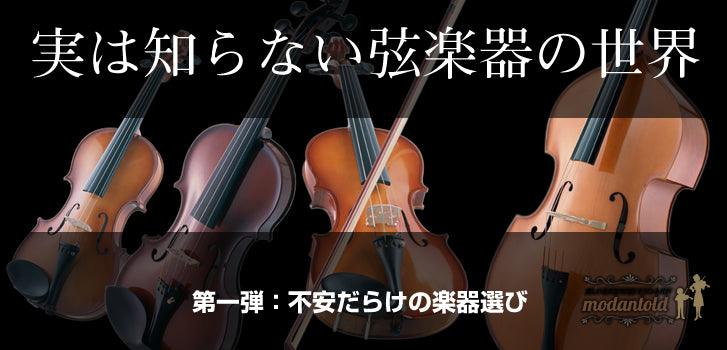

~ Musings from a String Instrument Concierge ~

When you feel like trying to play a musical instrument, who do you turn to for advice?
It would be great if you had a family member or friend who knew about them, but that’s not always the case, is it? The violin, viola, cello, and double bass—instruments you’ve always dreamed of playing. I imagine some of you might feel that visiting a specialty string instrument shop seems a bit intimidating.
The string instrument floor at TCGAKKI is a “welcoming string instrument specialty store” for everyone. When choosing an instrument, please feel free to ask us about anything. We’re sure you’ll be satisfied and think, “I’m glad I asked—so that’s how it works.”
The term “concierge” refers to a specialist at places like hotels who provides recommendations and guidance based on guests’ requests. We hope you’ll find these musings from our string instrument concierge helpful in turning your current “anxieties” into “peace of mind.”
Part 1: Choosing an Instrument Amid All the Anxiety (For Beginners)
String instruments are expensive and seem exclusive, making it hard to walk into a store

When people hear “specialty stringed instrument shop,” many seem to have the following image: “The instruments are expensive, and they only carry items in a completely different price range, so it’s hard to walk into the store. I feel like I’ll be stuck in a private room, like a reception area, and won’t be allowed to leave until I buy something. I get the impression that the staff will only pay attention to people who are knowledgeable about stringed instruments and skilled at playing them.”
The Appeal of Used String Instruments

When it comes to choosing between “new” and “used” string instruments, there are various perspectives, as well as pros and cons—but what should you keep in mind when making your selection?
“New,” in other words, refers to a brand-new instrument that has never been played by anyone. It has no scratches and is virtually free of defects. The biggest advantage is that you can enjoy playing it yourself while “breaking it in” from the very beginning. However, being new also means the instrument has only been in existence for a short time.
If we’re talking about cars, it’s immediately clear that new cars perform better, but when it comes to acoustic instruments, that’s not necessarily the case. As is often true with folk guitars, instruments that have been played for a certain amount of time—those that have been “broken in”—tend to have a better tone.

“Used” instruments may have scratches or a repair history, and in terms of appearance alone, they can’t compare to “New” ones. Yet, strangely enough, popularity is currently concentrated on these “used” instruments, and they are widely favored and used by many people.
Whether it’s “used” versions of current models or older instruments—such as modern or vintage pieces—some people may actually find a unique charm in the scratches and chipped varnish that give them a “used” look, rather than the pristine appearance of a “New” instrument. Where was this instrument made? By which luthier? Who owned it before, and how much was it played? Isn’t the greatest benefit of owning a “used” instrument the ability to enjoy the deep, warm resonance inherent to stringed instruments while letting your imagination wander through such romantic notions?Our store also features an open, relaxed space where beginners are welcome to browse at their leisure.
It doesn’t matter if you’ve never touched an instrument before or aren’t familiar with them. You’re more than welcome to just stop by to look around or try out an instrument. First and foremost, we want as many customers as possible to experience the cozy atmosphere of the TCGAKKI String Instruments Floor.

I don’t know much about manufacturers, models, or what makes a good sound
“I know the famous brands and models for clothes, bags, cars, and watches, but when it comes to string instruments, I’m not really sure which manufacturers are good, what the differences are between models, or even the pricing.
Since I have my own preferences regarding how an instrument looks and sounds, to be honest, I find it hard to decide whether to go with a New or used instrument.”
We often receive inquiries and consultations like these from our customers.
How to Choose an Instrument (Differences in Brands and Price Ranges, etc.)

String instruments like violins and cellos have a reputation for being particularly expensive, don’t they? TV programs sometimes feature violins worth over 100 million yen, but a professional musician can surely bring out the full charm of such an instrument through a moving performance that lives up to its rarity and value.
Because the string instruments commonly featured in the media tend to be expensive, they inevitably come across as high-end, but there are definitely affordable string instruments available that you can use with confidence.
Before you give up on the idea of playing the violin or cello because you think they’re too expensive, please feel free to consult with us at the TCGAKKI String Instrument Floor.
We’ll be happy to guide you toward a string instrument that fits your budget and needs. To be honest, while we naturally want to recommend high-quality instruments for our customers’ benefit right from the start, we also believe it’s a valid approach to start out comfortably and easily, discover the joy of playing, and then choose a model that suits you once you’ve become more skilled.

Typically, when you go to a music store looking for a New beginner’s instrument, you’ll likely be recommended a set priced around 100,000 yen. Cheaper options priced under 30,000 yen often aren’t durable enough for regular use, and low-priced models commonly sold online—made of plywood—may produce a poor sound or be so poorly adjusted that even tuning them is difficult.
Renowned violinists often advise starting with a New instrument costing 300,000 yen or more for practice, and there are models crafted with care by skilled artisans that cost over 1 million yen. It can be confusing to know what criteria to use when choosing, but as long as it allows you to play the pieces you love, is well-built, and puts you in the right frame of mind to enjoy music, isn’t that a perfectly fine string instrument?

Major manufacturers include the Japanese brands SUZUKI and Pygmalius, as well as San Antonio (made in China) and Karl Hofner (made in Germany). Stringed instruments are produced in various countries, including the Czech Republic, Hungary, France, and Italy; however, the top-selling choice for a first instrument is still SUZUKI, which is meticulously finished down to the finest details and can be used with confidence.German-made instruments are also popular because they offer substantial volume and a satisfying tone even as your playing improves, thanks to the many excellent workshops in the country.
In Germany—where violin-making is said to have been introduced from Brescia, Italy, in the early 17th century—large guilds were formed, and there were master luthiers whose work is said to account for as much as 90 percent of all old and modern violins produced worldwide.
A while back, instruments made in neighboring China didn’t have a very good reputation and tended to be shunned, but in recent years, China has become known as the world’s leading producer of violins. Today, there are many models that pay close attention to materials and varnish finishes, and we frequently receive inquiries from customers about high-quality stringed instruments with an antique finish. While there may be some roughness in the finer details of the exterior, these instruments are recommended for those who prioritize performance.

When it comes to the birthplace of stringed instruments, many people probably think of Italy. While it has produced famous luthiers such as Stradivari and Amati, high-end models are still crafted in the Cremona region today. There also seems to be a trend toward appreciating them not merely as instruments, but as works of art and craftsmanship. The fine grain of the wood and the beauty of the varnish finish further enhance their elegant tone. It’s the kind of instrument you dream of owning someday, isn’t it?
So, what is a reasonable price range to aim for when buying a used instrument?
While this is merely a guideline, taking models with a list price as an example, the basic selling price for a used instrument is generally about half that list price. Although prices fluctuate depending on popularity and demand, this means a model with a list price of 300,000 yen would cost around 150,000 yen used. If you were to spend the same amount—150,000 yen—on either a New violin with a list price of 150,000 yen or a used one, which would you find more appealing?
Concerns about the quality of used instruments and repair warranties
“New products have no scratches or defects, so you can use them with peace of mind, but I’m somehow worried about used instruments that someone else has played. What if they stop producing sound right away or break? I’ve heard there are also ‘old’ string instruments, and I wonder if older instruments can even be repaired today. I’m also concerned about after-sales care (warranty) after the purchase.”
Are you hesitating to buy a used instrument for reasons like these?
About Quality and Warranties
Naturally, you may feel hesitant about buying a used instrument for the first time. Some of you may have had the experience of buying a cheap instrument in the past only to have it break immediately. However, at TCGAKKI, we won’t let you have that kind of unpleasant experience. Any instrument that requires repairs or adjustments is thoroughly restored by skilled craftsmen before being sold.If there is a history of repairs or any potential future concerns, we’ll explain everything clearly and transparently so you can make an informed decision. We also offer a one-year warranty for your peace of mind after purchase. We’re here to provide solid support in case of any issues, so you can enjoy playing your instrument for years to come. Furthermore, TCGAKKI isn’t just about sales. If you no longer like your instrument or decide you’d rather have a different one, you can “trade it in.”If you return the instrument within one month of purchase, we will accept it as a trade-in at 80% of the purchase price (excluding tax). Nothing is more regrettable than giving up on playing a string instrument without ever experiencing its true charm. Even if you start with a lower-priced model, we’ll help you upgrade to a higher-quality instrument as your skills improve, so you can enjoy playing string instruments for many years to come.
* The one-month trade-in guarantee applies to items purchased for 20,000 yen or more (excluding tax) that are in the same condition as at the time of purchase. It also applies only if the price of the new item is equal to or greater than the value of the trade-in item. Shipping costs are the customer’s responsibility.
* Of course, even after the period has passed, we’re happy to assist you with a trade-in at any time. Feel free to contact us even if you’re only interested in selling your instrument.
* If your instrument starts malfunctioning or stops producing sound after purchase, we’ll handle the repair free of charge. Please feel free to contact us.
However, a fee will apply in the following cases:
|
| ・If you request modifications or special adjustments ・If the item has been repaired or modified by a party other than our store ・If the item is damaged due to customer negligence or intentional acts ・Modification or alteration of parts ・Repair of scratches, repainting, or polishing ・Replacements or repairs necessary to achieve a custom setup ・Products not covered by warranty ・Repairs may not be possible in some cases, such as when certain parts are difficult to obtain. Additionally, the tone or playing feel may change after repairs ・Used items are not covered by any manufacturer’s warranty ・You are responsible for all shipping costs associated with sending the item for repair and receiving it back ・Items will not be covered under warranty if you do not present the warranty certificate |
Afterword
When it comes to the string instruments you’ve always dreamed of, questions like “Will I ever be able to play this?” “Will I be able to stick with it?” “What do I need to get started?” and “There’s so much I don’t know…” are bound to arise. It’s only natural to feel anxious when choosing an instrument.
Just watching someone play the violin or cello can be soothing, or it might make you irresistibly curious. You’ll feel that excitement every day, while occasionally feeling a bit lost. These are the first precious moments that string instruments give you.From the very day you get the string instrument you’ve always dreamed of, a whole new daily life begins.
No one can play well at first. Even the violinists you admire weren’t good at first. Days spent handling your instrument while imagining yourself as a skilled player—this is the second precious time that an instrument gives you.
What matters most is that you’re enjoying life with your string instrument. A happy life filled with the joy of music—that’s the third precious moment a string instrument offers.
TCGAKKI’s string instrument floor always has over 200 used string instruments in stock. It’s a soothing space where you can relax in an open area and browse at your leisure for as long as you like. Don’t feel any pressure—it’s perfectly fine if you don’t buy anything that day.Many customers come just to browse or try out instruments. We also offer lessons taught by professional instructors. If you have any concerns about selecting an instrument to purchase, please feel free to consult with us in-store, by phone, or via email.
Our store is a charming and playful space full of excitement where you can discover hidden gems and treasures just for you. At the same time, we’re a string instrument specialty shop that’s welcoming to children and their parents who are working hard at their lessons, as well as beginners looking to start playing a string instrument.