
Hello!
I’m Takechi from the repair department at Okubo Gakki 🎷
Saxophones, like most brass instruments, are made of a metal called “brass,” but did you know that cork and felt are attached to each and every one of their tiny parts? (・・?
These materials are essential at the points where keys interlock or where keys come into contact with the body of the instrument, and we use over a dozen different types and thicknesses depending on the specific location…! 👀
Today, I’d like to talk about a secret point of pride for craftsmen: the types of cork 📖

The photo above shows the back of the left-hand side of an H. Selmer SERIE 2 alto saxophone.
To prevent metal parts from rubbing against each other, white and brown cork, PVC tubing, green felt, and other materials are attached to numerous spots in this area alone.
Deciding what to attach where on the keys is crucial for tuning, and we select the thickness and material based on the manufacturer, model, and key structure.
To put it bluntly, in some cases, even a 1mm difference in thickness can cause a key to lift, preventing it from producing sound. Good kids, please don’t try this at home! 😱
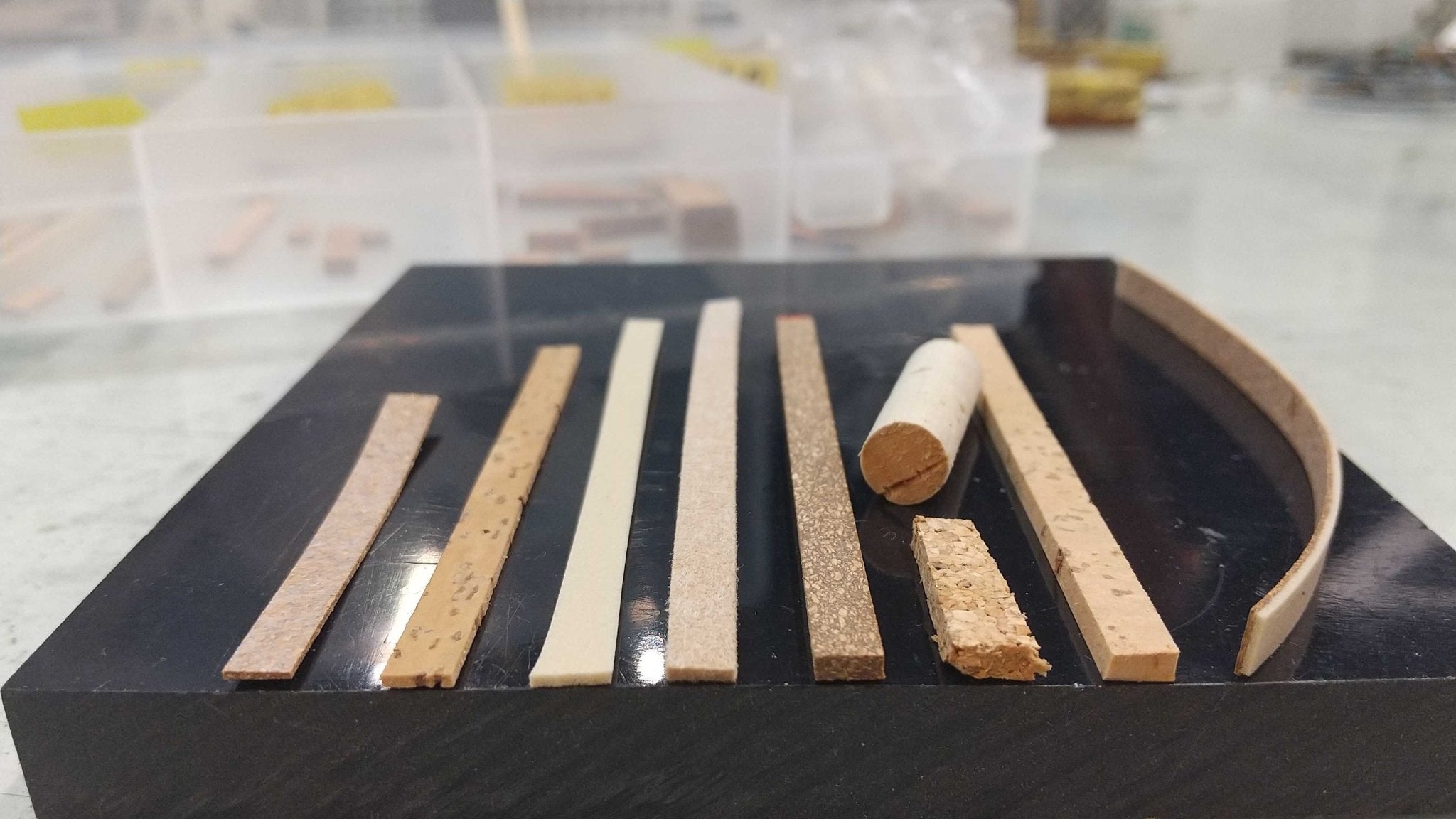
The photo below shows the cork I mainly use. Different materials have different characteristics; some typical examples are:
(Far left) Synthetic cork: Resists deformation under pressure and is resistant to moisture and oil absorption. It’s durable.
(Second from the left) Natural cork: It changes shape easily under pressure and absorbs moisture and oil readily. It provides good cushioning and minimizes noise.

I select the material and thickness based on the specific key location—factors like whether it’s prone to moisture, subject to heavy pressure, has a large or small contact area, or how much key travel I want, etc.
However, since cork and felt are consumable materials, even if you handle your instrument with care, they will deteriorate over time due to hand sweat, moisture, and oil absorption, eventually becoming hard and brittle.
By the time the entire instrument starts making rattling noises, other issues have often already arisen, so we recommend bringing it in for maintenance as soon as possible! 🙏
Check out this video where I actually try out the instrument before and after repairs ↓
“It Makes a Huge Difference! Saxophone Repair: Before & After!”
https://youtube.com/shorts/NXhufJyI80U
Which condition does your instrument most closely resemble? Please use this as a reference. 💁♀🛠