
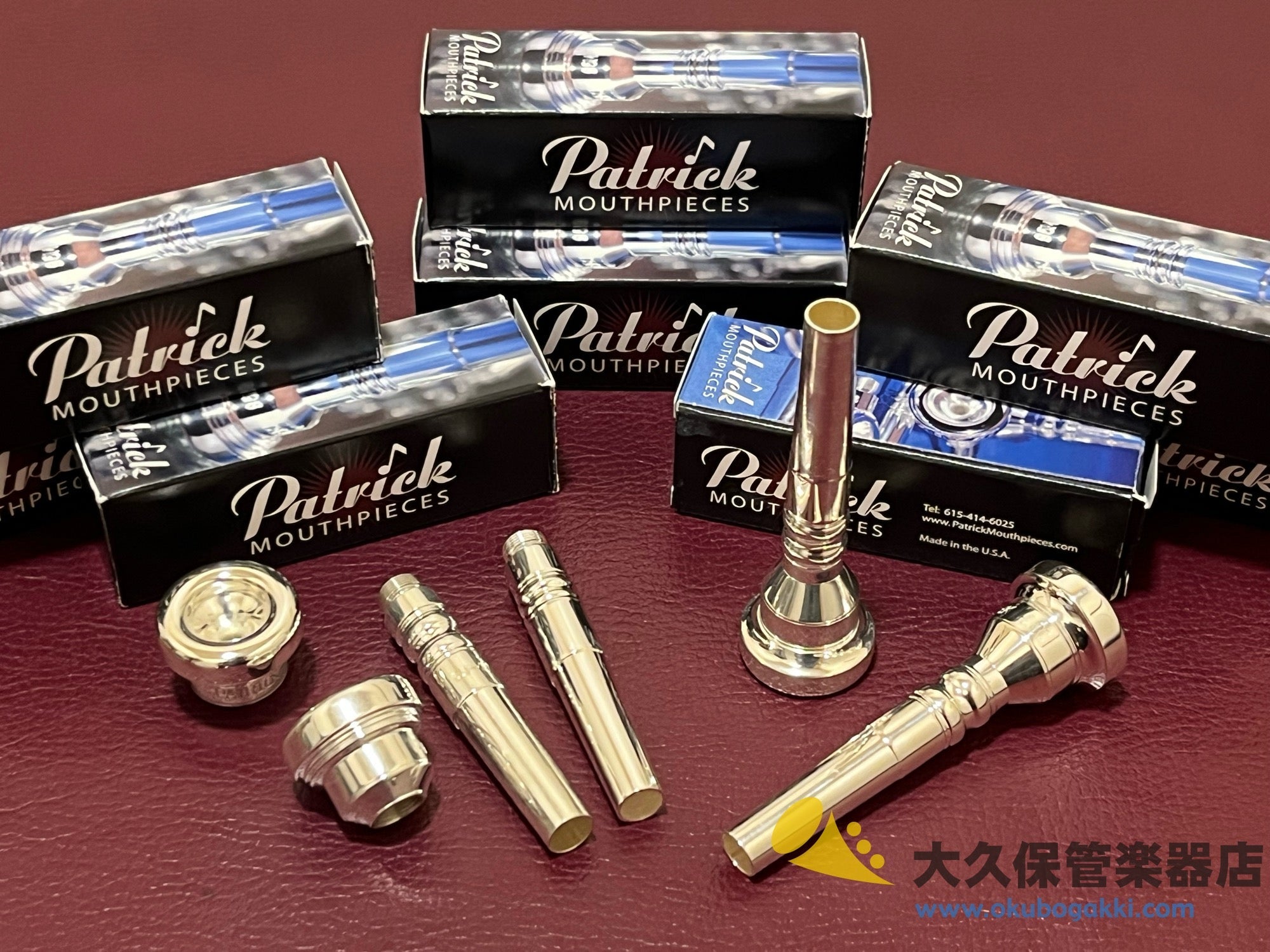
This is Nakamura from Kubokan.
Today, I’d like to introduce “Patrick,” a mouthpiece that’s been getting a lot of attention lately.
Steve Patrick is a top studio musician from the U.S.
First, please listen to this cover of Maynard Ferguson’s “Give It One.”
There was also a video of him playing another song, complete with sheet music.
He handles everything from video game and film scores to numerous albums and thousands of recording sessions across all genres, while also performing frequently with classical and orchestral ensembles—he’s a true “superman” capable of delivering high quality in everything he does.
The mission of Patrick mouthpieces is to allow players to easily express their musical ideas and to ensure that there is absolutely no compromise in sound or playability, even when switching between musical genres.
When I read this explanation, it made perfect sense to me. While Patrick Mouthpieces are primarily designed as two-piece models, I realized they’re intended to cater to every aspect of today’s diverse music scene.
That was a long introduction, but now let’s move on to the product details.
Honestly, the lineup is so extensive that covering everything is quite a challenge. I’ll focus on introducing the flagship products.
(Text in color represents Nakamura’s personal thoughts.)
ーーーーーーーーーーーーーーーーーーーー
● Commercial Series
This is Patrick’s flagship model.
Rooted in older Jet Tone models, they offer a slight resistance, excellent endurance, and deliver better projection and stable high notes. You can choose from three types of rims. (See below.)
It can be made as either a one-piece or two-piece model, but according to Patrick, the two-piece version is recommended for the Commercial Series. The CM backbore is a good match. In some cases, slightly more open backbores like the Z or CL may be preferred.
For the one-piece configuration, the CM is the standard option.
Although the backbore is tight, it doesn’t feel constricting, nor does it allow too much air to enter—it provides just the right amount of resistance. It has a rich tone, similar to the GR, and feels more efficient to play than the shallow mouthpieces from other manufacturers.

The cup depth comes in two sizes: M and S.
Since even the M size is reasonably shallow, most people choose this option.
The S size is recommended for players who regularly use shallow mouthpieces or who need to perform under extreme conditions.
There are three rim shapes to choose from.
FR (Flat Rim)
A flat rim. The high point is located in the center to slightly toward the inside, making it difficult for the lips to slip into the cup.
Many of our customers choose the FR rim.
RR (Round Rim)
The widest rim. It has a cushioned, rounded shape similar to Jet Tone’s C-rim. The high point is positioned slightly toward the inside, designed to prevent the lips from slipping into the cup.
Those who prefer the EM model tend to favor the RR rim.
CR (Comfort Rim)
A rim that is narrower than the two mentioned above. It offers more cushioning than the rims in the Classical Series and provides superior support. The high point is located on the inner side of the rim, so it may feel slightly smaller.
Recommended for those familiar with Bach rims who want a bit more cushioning. We recommend selecting one size larger.
ーーーーーーーーーーーーーーーーーーーー
● Classical Series
Patrick’s standard model, refined from the Vintage Bach design to deliver a comfortable rim and excellent playability.
All models are notable for their rich, full sound, excellent playability, and clear articulation. It’s particularly innovative that even with smaller mouthpieces—such as the 5C, 7C, and 10-1/2C—the cup design, equivalent to a 3C, prevents the sound from becoming compact and maintains a rich tone.

The rim has a slightly softer feel than the Back model, but it features a rounded profile that many players find easy to adapt to.
Both one-piece and two-piece models are available, but according to Patrick, the one-piece version is recommended for the Classical Series. For two-piece models, the back bore sizes CL or CLP are compatible.
For the one-piece configuration, CL is the standard specification.
● About the Backbore
Commercial (CM): Features a long straight section and a slower opening, resulting in the tightest taper
Z: Opens slightly later than Classic (same taper angle as Classic)
Classic (CL): A back bore with a standard opening rate.
Classic Plus (CLP): The back bore with the fastest opening and the widest diameter.
Most customers who purchase a top from the Commercial Series choose the CM backbore.
For those who want a little more flexibility or width, choose the Z backbore; for those seeking the width to accommodate a Classic model with a shallower cup, choose the CL or CLP.
Custom backbores for piccolo trumpets are also available.
ーーーーーーーーーーーーーーーーーーーー
That concludes Patrick’s basic lineup.
...Wait, you can’t remember it all?
These are great mouthpieces, so even if you’re not sure which one to choose, please give them a try.
Of course, you can try them out in-store, but we’re also happy to assist you over the phone, so please feel free to contact us.
Click here to visit the product page.
Nakamura