
Part 5: Stingray
~ The NAMM Anniversary Model Celebrating Its “100th Anniversary”!! ~

Hello, this is Karibe m(__)m
We received some warm comments from customers who read our previous feature, “KAWAI ‘Moonsault’ — Captivated by the Romance of Space.”
Once again, thank you so much to everyone who took the time to read it! m(__)m!! We receive a large number of instruments every day, but among them… I’d like to introduce a bass that (personally) caught my eye!! The model I’m featuring this time is a classic bass model on par with the Jazz Bass and Precision Bass…
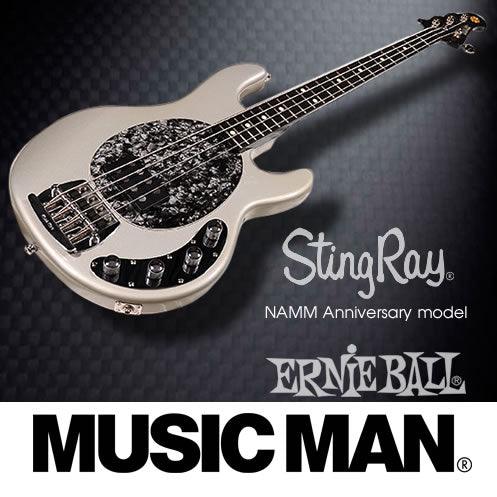
The Music Man “StingRay”!!
What is Music Man…?
MUSICMAN was founded in 1972 by Leo Fender, the founder of Fender, to realize his “engineer’s spirit”—his desire to devote himself purely to developing new products as an engineer and developer. Together with Tom Walker, who was designing amplifiers at the time; Forrest White, then vice president of Fender;and Derrell Hyatt, who held a key sales position, to launch a new brand. They introduced guitars and Basses that incorporated ideas groundbreaking for their time.
The “Stingray Guitar” and “Stingray Bass,” introduced in 1976, were equipped with active circuits; their innovative design and cutting-edge sound instantly attracted attention. This was followed by the release of the Saber Guitar in 1977 and the Saber Bass in 1979.Although Music Man—founded by Leo Fender—sold its rights to Ernie Ball in 1984, the company continued to carry on the tradition of the original Music Man, releasing various models that incorporated new ideas.
From Edward Van Halen (EVH) to Flea (Red Hot Chili Peppers), Cliff Williams (AC/DC), Steve Lukather (TOTO), and Keith Richards (The Rolling Stones)—and many others—Music Man has become a quintessential, iconic brand of guitars and Basses, cherished by a wide range of artists from its inception to the present day.
The instrument we’re introducing today is a rare limited-edition model—one of only 100 made worldwide—created to commemorate the 100th anniversary of “NAMM,” the world’s largest music trade show where instruments and equipment from around the globe are showcased!!
MUSIC MAN Stingray ~ “100th NAMM Limited Edition” ~

|
| ||||||||||||
|
| ||||||||||||
| ||||||||||||
|
| ||||||||||||
Let’s take a look at the whole thing right away (∩ ̄∇ ̄)∩"
Neck
This model features a Status graphite neck—arguably one of its standout features—and


and the headstock features an embedded “100th NAMM” medallion.

Body
Featuring the same unique single-pickup layout that has remained unchanged since its debut,

a 3-band active preamp, delivering a powerful and clear tone that combines the rich sound of a Precision Bass with the versatility of an active pickup.

The joint features a sturdy 6-point bolt-on construction.

The bridge features a through-body design with a mute sponge attached.


Although the Stingray has a rugged image with its single pickup, it reveals a variety of facets depending on playing style and the 3-band equalizer, making it a versatile instrument capable of solidly supporting the band’s low end even on its own ♪
A product description alone can be a bit boring, so let’s take a closer look at this model’s distinctive neck (σ ̄∀ ̄)σ!!!
What exactly is synthetic resin??
When it comes to parts that significantly affect the sound—starting with the body and pickups—the list is endless…
In addition to well-known woods like maple and mahogany, there are also “synthetic resin” necks—such as carbon fiber and graphite necks—which we’re spotlighting today!!
When you hear “synthetic resin materials” like carbon, what comes to mind?? Airplanes, rockets, cars, motorcycles, bicycle parts, computer components, golf equipment, fishing gear, watch parts, and so on… These materials are used in a wide variety of fields today.
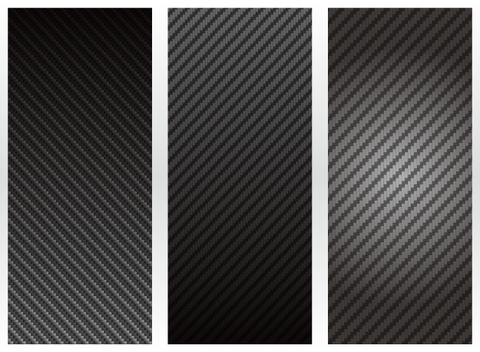
Generally, the synthetic resin materials used in guitars and Basses are primarily made of carbon fiber, and brands such as STEINBERGER, ZON, Modulus, Moses, Status, Parker, and others manufacture them using their own unique methods.

It seems that terms like “carbon fiber” and “graphite” can vary depending on the specific material used or the composition ratio, but since I don’t know the finer details myself, please check the manufacturers’ websites for more information ♡
Pros and Cons of Each Material
Let’s do a quick comparison with two representative woods: maple and mahogany♪
◎ Maple (Hard Maple)

-Pros-
・Commonly used for necks. It’s strong and produces a clear, resonant sound. It’s also used for fingerboards.
-Disadvantages-
・It’s relatively heavy, and pieces with beautiful grain patterns—such as tiger stripe, quilted, or bird’s-eye—can be quite expensive.
◎Mahogany

-Pros-
・It has long been used for necks and other parts, and is characterized by soft, warm mid-to-low frequencies compared to maple.
-Disadvantages-
・The wood is relatively soft, which makes it prone to breaking…
◎Graphite

-Pros-
・Compared to wood, it is more durable and less susceptible to weather conditions, and is characterized by few dead spots.
-Disadvantages-
・It is expensive. Because it is hard, the sound is relatively tight. Since it is resistant to warping, it is difficult to repair if it does warp.
Patterns on the Back of Necks by Manufacturer
Even though we generally refer to them as “carbon” or “graphite,” there’s actually a wide variety. Let’s take a look at the back of the neck for each manufacturer♪
◎STEINBERGER

Jet black!! ...It’s painted, isn’t it? (lol)
◎Modulus

The pattern is angular!? This is a signature feature of Modulus♪
◎Status

That’s a pattern that really looks like “carbon,” doesn’t it? (∩ ̄∇ ̄)∩"
[Bonus♡]
There’s more!! Wood used for instrument necks!!
・Wenge

・Ovangkol

・Rosewood

・Sapele

・Aluminum

In addition to these, there are also laminated constructions that combine different types of wood♪


By laminating different types of wood together, the neck’s strength and sound characteristics vary♪
Afterword
While putting together this feature, I wondered, “What makes the Bass a little different from the norm??” and various models came to mind…
But then, while listening to one of my favorite bands, it suddenly hit me: “It’s graphite!!” So I decided to make it the focus of this feature m(__)m However, even when I researched the concept of “synthetic resin necks,” it turned out to be a project that wasn’t as straightforward as I’d hoped.
To begin with, synthetic resin materials—including graphite—have different names depending on the manufacturer and material ratios, so as I researched, I found myself getting completely confused (; ̄Д ̄)"
Enough with the technical jargon—anyway, please be sure to come try out the instruments featuring graphite at our store! ♪
It’s a short section, but I’ll keep updating it whenever we get any rare or interesting basses in stock! ♪
...Well then, see you next time for the next feature! (´▽`)ノジ