
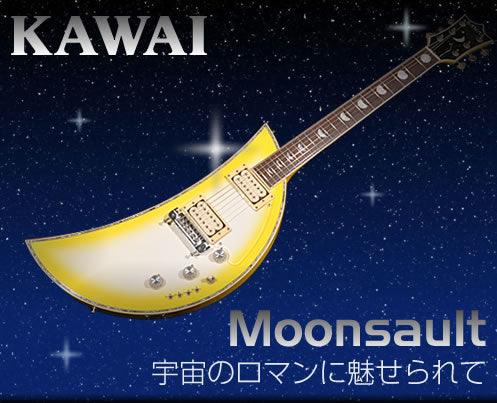

Part 4: KAWAI "Moonsault" ~Captivated by the Romance of Space~

Hello, this is Karibe m(__)m
We received some warm comments from customers who read our previous feature, “Ibanez ‘Paul Stanley’ Signature Models!!”
Once again, thank you so much to everyone who took the time to read it m(__)m!!
We receive a large number of guitars every day, but among them... a guitar with a particularly striking presence has arrived!!
The guitar I’d like to introduce today is the “Moonsault” from “KAWAI,” a Japanese brand also known for its pianos!!
About KAWAI…
KAWAI (Kawai Musical Instruments / Kawai Musical Instrument Manufacturing Co., Ltd.) was founded in 1927 as the Kawai Musical Instrument Research Institute by Koichi Kawai, who had previously worked at Nippon Gakki (now Yamaha Corporation).
The company manufactures and sells musical instruments, primarily pianos. *It has since ceased production of electric guitars, electric basses, and similar instruments.
In 1958, the company began manufacturing classical guitars, and in 1963, it started producing electric guitars for export to the United States. In 1967, it merged with Tesco to increase production and expand exports.
In the 1970s, while producing copy models under the Tesco brand, the company began OEM production for the domestic market in the mid-1970s. In 1977, after accumulating approximately 20 years of experience, it finally unveiled its original models. Today, the brand boasts a history of guitar manufacturing spanning more than 50 years♪
◎KAWAI '80 Moonsault

|
| ||||||||||||
|
| ||||||||||||
| ||||||||||||
|
| ||||||||||||
A strikingly eye-catching, unconventional crescent-shaped body.
Inspired by the 1970s—an era when humanity expanded its horizons into space, beginning with the U.S. Apollo program that achieved a moon landing—Kawai embarked on the creation of an original guitar model themed around “a tale of the cosmos.”
Unveiled at the 1977 Musical Instrument Fair, where it garnered significant attention, it was released in March 1978 as the definitive model in Kawai’s original guitar lineup.
Its innovative guitar design defied conventional wisdom for its time. And the controls, which incorporated a built-in preamp and Effector...
In the 1970s, as the electric guitar boom gained momentum, domestic guitar manufacturers were locked in a “copycat war” competing to produce authentic vintage replicas—but this was one of the very few that pursued an original design, making it the ultimate instrument!!
The original Moonsault was produced from March 1978 to February 1985. Even after production ended, it spawned various derivative models, and with reissues and replicas continuing to appear, it remains a true Japanese masterpiece that enjoys enduring popularity to this day!!
Let’s take a look at it right away (∩ ̄∇ ̄)∩"
Body


Its unique crescent-shaped body was created by re-examining ergonomic data and performing proprietary calculations.
Based on that data, the design was refined time and again. While the distinctive crescent-shaped body might seem to prioritize aesthetics, it was actually crafted through early “ergonomic” calculations to prioritize balance and playability.
The pickguard is made of acrylic

A Badass bridge is used.
*This part will be replaced.

The color is “Moon Light Yellow.”

At launch, it was available in two colors: Silver Burst and Cosmo. Subsequently, various other color options were introduced, including this model’s Moonlight Yellow, Crystal (acrylic body), Metallic Red, and more.
Head


At first glance, the head appears to have an ordinary design...
...but its distinctive, angular design is inspired by a “star,”

The headstock features a jet-black cosmic design, with a crescent moon inlay and stars scattered across it

And the truss rod cover is rocket-shaped, said to be inspired by “Apollo 11”

Let’s take another look at the headstock… a close-up (∩ ̄∇ ̄)∩!!

The headstock depicts a rocket blasting off into outer space (´▽`)ノジ
Grover 102 tuners are used.

Back then, silver-toned finishes were the standard for anything space-themed, so—just like the
bridge—silver-colored parts were naturally chosen for the tuning pegs and other metal components.
Fingerboard
Unique position marks.

They depict the phases of the moon—from full moon to crescent moon (or perhaps a sliver of moon?) ♪
Inlays
The position marks feature white mother-of-pearl,

Mexican shell for the binding inlays

Meticulous craftsmanship even on the corners!!

Even the smallest details are crafted with care (*っ´ω`)っ"
Neck

The neck has been crafted with an original, ergonomically designed shape—just like the body—so that players switching from Fender-style or Gibson-style guitars can play it comfortably without feeling any discomfort.
Joint

A set-neck construction is used at the joint between the neck and body.
A curved cut is applied to reduce stress in the high frets, enabling smooth fingering.
Controls
Based on the sound concept of “Fender and Gibson tones in a single guitar!!,” the circuitry combines various switches and preamps, similar to B.C. Rich models.
For the pickups, based on the “all-purpose” concept—capable of producing both humbucker and single-coil sounds—


featuring two original “DSU Humbucking Pickups” ヽ(´▽`)/!!
The controls are:

(1) Master Volume
(2) Preamp Volume
(3) Master Tone
(4) Pickup Selector.
The mini switches, viewed from the toggle switch side, are:
(5) Preamp ON/OFF
(6) Booster/Distortion
(7) Dual Sound Switch (Coil Tap)
(8) Phase Switch
.
A Little Story Behind the Name
The name “Moonsault” comes from an ultra-difficult trick devised by Mitsuo Tsukahara, who was a member of the Kawai Gymnastics Club at the time.
It was used as the finishing move on the horizontal bar and was the signature move that earned Tsukahara a gold medal at the 1972 Munich Olympics.
Although he himself referred to it as a “backward double somersault with a twist,” a foreign announcer praised it as “It’s just like floating in space!! A moonsault!!” From then on, the name “Moonsault” stuck. When naming this guitar, the development team recalled this moment and chose the name with the hope that players would “play the guitar with the image of their picking hand shooting out into space.”
Finally...
In putting together this feature on the “KAWAI Moonsault,” I once again drew on catalogs, magazines, the internet, and feedback from our customers m(__)m
I hope to continue creating this column with the support of our customers m(__)m
Although it’s a short column, I’ll update it whenever I come across a rare or interesting guitar♪
...Well then, see you next time for the next feature! (´▽`)ノジ
1 Comments
jorge Villa
Awesome article! thanks!