
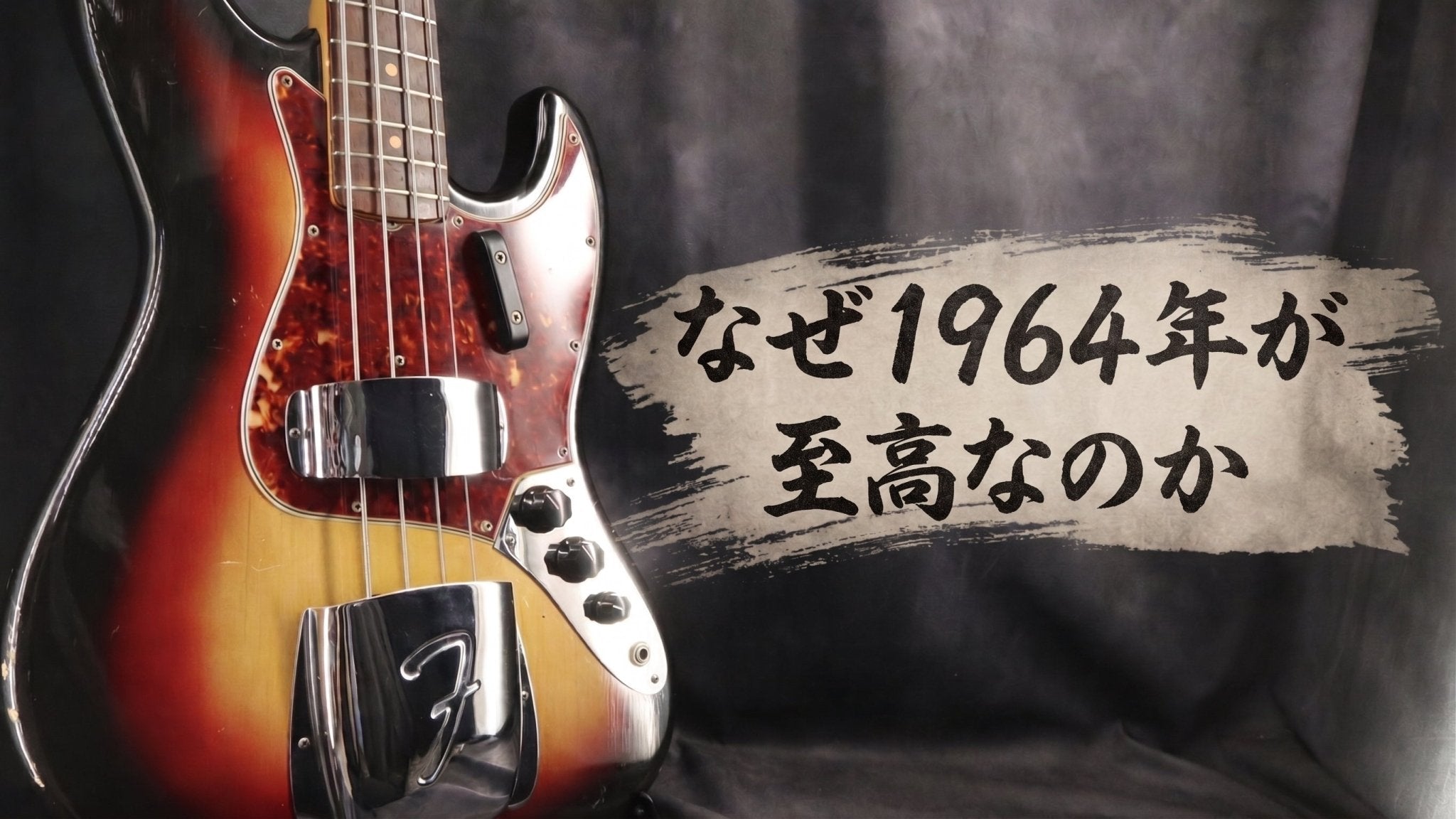
The Fender Jazz Bass was introduced in 1960.
It has remained the standard for all bassists, and even now, more than 60 years after its debut, it continues to be played on the front lines of the music scene while retaining its original shape and basic design.
While Fender’s reissue models recreate instruments from numerous eras, there is one specific era that is spoken of with special reverence in the vintage market as the “ultimate form.”
That is the 1964 model.
1. The Final Glory of the “Pre-CBS Era”
Why is the year 1964 held in such high regard?
One of the main reasons lies in Fender’s historical background.
In 1965, Fender was acquired by CBS, a major media conglomerate. As the company entered the so-called “CBS era” following the acquisition, mass production accelerated in response to the global electric guitar boom, leading to cost-cutting measures, streamlining of manufacturing processes, and various specification changes.
Consequently, instruments from the “Pre-CBS era (1960–1964)—into which founder Leo Fender’s design philosophy and the passion of skilled artisans for handcrafted work were poured without reserve—reign as the “golden age” on the vintage market, commanding overwhelming value.
And 1964 marks the “final year of the golden age” within that Pre-CBS era.
2. Evolution Since 1960
In the history of the Jazz Bass, the early models made from 1960 to 1962 are also extremely popular.
Let’s take a look at the differences in sound and specifications between them.
・1960–1961
Featured double-stacked “stack knobs.” The fingerboard used a “slab board” made of rosewood laminated flat.
・1962
Transitioned to a “3-knob” configuration with two volume controls and one tone control. Characterized by a thick, sticky, and viscous low end produced by the slab fingerboard and “black bobbin” pickups, this is also a highly popular era for reissue models.
・1963
: The “round-laminated” method, in which a thin layer of rosewood is laminated to follow the curve of the neck, was adopted.
・1964
: The body-mounted mute was discontinued.
“Gray bobbin” pickups were adopted.
“Clay dot inlays” (changed to pearloid the following year, in 1965) are also a signature feature of the Pre-CBS era.
If the 1962 model is characterized by a thick, lingering tone, the 1964 model features a tone with improved high-end definition and response.
The 1964 model blends naturally into any ensemble and offers such excellent balance that even modern players find it “the easiest to play.”
3. Changes in the Popular Music Landscape
In the mid-1960s, the world of record production was undergoing drastic changes due to advances in multitrack recording technology.
Band ensembles became more complex, and it was an era marked by the increased volume of electric guitars and the creation of dense tracks with multiple layers of strings and horn sections.
This presented a challenge: the thick, heavy bass tones of the past would get lost in the crowded ensemble.
It’s easy to imagine that the 1964 model, with its “defined high-end and overwhelming response,” was a perfect fit for the music scene of that time.
It’s no exaggeration to say that the “pleasing bass sound” we hear in popular music every day was created by the Pre-CBS-era Jazz Bass.
It makes perfect sense, then, that 1964—the final year of the Pre-CBS era—is referred to as the “perfect form of the Jazz Bass.”
To be honest, when it comes to the ’60s reissue models Fender has released so far, the 1962 model is by far the most common (such as the Fender USA/American Vintage ’62 Jazz Bass and the Fender Japan/JB62).
Even in the vintage market, there’s a long history of models with slab fingerboards—particularly those from around 1962 or earlier—being highly valued, including in terms of price. Their iconic look, featuring a generous use of rosewood on the fingerboard, and their solid, thick bass tones. Perhaps it was only natural that the slab fingerboard era would be favored in the context of being “the origin of the Jazz Bass.”
However, when we step back from historical assessments and focus on the practical experience of players, there is something about the round fingerboards introduced in 1963 and later that simply cannot be overlooked.
In contrast to the tenacious low end of the slab fingerboard, the round fingerboard produces a sharp attack that rises instantly upon plucking, along with a well-defined tone that cuts cleanly through a crowded ensemble.
Given that later models have continued to adopt the rounded fingerboard, it’s clear that the rounded fingerboard is by no means merely a “follow-up” to the slab—rather, it is the “specification best suited for a practical jazz bass,” arrived at by responding to the musical demands of the stage.
Now, the instrument we’ve just received at our store is precisely that 1964 model.

Fender 1964 Jazz Bass![]()
The sunburst finish has faded very little, and with only a few spots of paint peeling, this instrument is in exceptionally good condition.
Although it shows some wear and tear commensurate with its age, it comes with the rare original hard case. Furthermore, the pickup fence and bridge cover (without the mute sponge) are still intact.


This instrument is not merely a collector’s item to be admired. Our in-house repair technician has set it up to ensure a stress-free playing experience.
It is a truly exceptional instrument that exudes an overwhelming presence as an “active instrument” ready to produce the ultimate sound on stage or in the studio.

After nearly 60 years, this is a special bass that allows modern players to experience the “Golden Age of Fender.”
The moment you play the open 4th string, you’ll feel the swift low-end—a sound that only a vintage bass can produce.
Why not come experience this sublime tone for yourself?
Available for trial in-store!
Feel free to contact us via email or chat!
Oda