
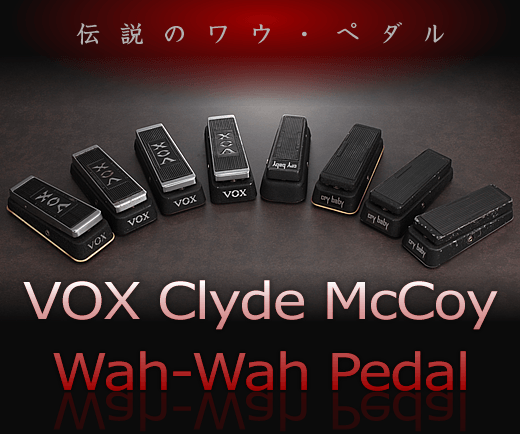

The Legendary Wah-Wah Pedal: VOX Clyde McCoy Wah-Wah Pedal
Hello, everyone! It’s been a while since my last Effector column, and today I’d like to feature the VOX Clyde McCoy—the world’s first commercially available wah-wah pedal. Wait, does that mean…?! That’s right!! We at THE Used Music Store have managed to secure some incredibly rare, authentic units that you’d be hard-pressed to find anywhere in the world (^O^)v—and we have plenty of them!!
First, I must make a quick note: “The EFFECTOR BOOK,” published by Shinko Music—a company we frequently work with and have collaborated with on interviews—is truly the bible for Effector enthusiasts.In Volume 2 of that book, writers Shinpei Hosokawa and Kazuhee (TEXAS BLOOD) have compiled wonderful, meticulously detailed articles on this topic. So, while I’m fully aware this will overlap with their work, I’d like to pay my respects to their articles and—though I’m a bit embarrassed to admit it—write my own take on the subject.

Alongside fuzz, the wah-wah pedal is one of the oldest Effectors in existence, capable of producing a sound similar to the “wah-wah” effect created by a trumpet player using a mute. In principle, it is an Effector that utilizes a filter circuit with a specific resonant frequency; by directly operating a variable resistor (pot) with the pedal, the frequency point is continuously adjusted to alter the tone.The variable resistor (pot) and the pedal are linked via a rack-and-pinion mechanism. While this circuit might be considered extremely primitive by modern standards, even with today’s advanced electrical technology, this classic circuit remains a mainstream favorite among many guitarists for its tonal qualities.
This filter circuit is an LC resonant circuit that uses an inductor and a capacitor.The resonance frequency and peak height (Q), determined by the inductor and capacitor, shape the character of the tone. Although it is a simple circuit with very few components, the sound produced varies significantly depending on the inductor and capacitor, as well as differences in the potentiometer and transistor (including individual variations).
Now, let’s take a look at the history of the wah-wah pedal. (*Dates are approximate.)
In the mid-1960s, during the British Invasion led by The Beatles and The Rolling Stones, VOX was the most successful brand, releasing the Phantom series of guitars as well as the AC-15, AC-30, and AC-100 (Super Beatle) amplifiers.The company behind the VOX brand was JMI (Jennings Music Industries) in the UK, and Thomas Organ in the U.S. served as the import distributor for VOX’s expansion into the American market.
Thomas Organ did not limit itself to import operations but also collaborated with JMI on the development of VOX amplifiers.The AC-100 “Super Beatle”—used by none other than The Beatles—was also a product of Thomas Organ. It is said that the mid-range booster circuit installed in that “Super Beatle” amplifier was accidentally created while Thomas Organ engineer Brad Plunkett was modifying it. Based on that, JMI incorporated the circuit into a VOX volume pedal—which was already on the market at the time—and completed a prototype. This took place around 1966.It appears the prototype was delivered directly to prominent musicians such as Jimi Hendrix.
When the product was released to the market, manufacturing was handled by EME (Electonica Musicale Europea) in Italy. EME was a company established in the early 1960s as a joint venture between JMI, Thomas Organ, and the Italian musical instrument manufacturer EKO; it also manufactured VOX guitars and organs.

In February 1967, the first VOX wah-wah pedal released to the public was named “THE CLYDE McCOY WAH-WAH PEDAL.” Clyde McCoy (1903–1990) was a trumpeter known for his use of the wah-wah mute (a technique where the bell of the trumpet is covered with the hand or a mute), and his portrait was featured on the back cover of the pedal.The release date is inferred from the timing of the promotional record for the wah-wah pedal released by VOX/Thomas Organ. Additionally, Clyde McCoy’s portrait was removed around 1968 and replaced with just the logo. Toward the end of production, some units had nothing printed on the back cover. Specifically, models featuring the portrait are called “Picture,” those with only the logo are called “Signature,” and those with no markings are called “No-Logo.”
The sound of the wah-wah pedal, which had only recently been introduced, can be heard on “Tales of Brave Ulysses” (recorded in May ’67), a track from Cream’s second album, *Disraeli Gears* (also known as *Colorful Cream*), led by Eric Clapton.It appears that Eric Clapton purchased a Clyde McCoy Wah at “Mannys,” a music store on 48th Street in New York, for that recording session. It’s amazing how Clapton was able to create that magnificent, historic masterpiece using a brand-new, unknown Effector he’d just acquired.

In late ’67, at the request of Thomas Organ—the VOX distributor for the U.S. market—the “Crybaby” was introduced. Like the “Clyde McCoy,” it was manufactured by EME in Italy and had the same internal components, but the early models featured a rounded, slightly slimmer enclosure and a logo on the top of the pedal, earning them the nickname “Top-Logo.”

Around 1968, the “Clyde McCoy” changed from the “Picture” version to the “Signature” version, which featured only the logo, and the “Crybaby” was also redesigned with a standard enclosure, becoming the “Crybaby MODEL 95-910511.”

Around 1969, the “Clyde McCoy” was renamed the “WAH-WAH MODEL V846.”
Between 1969 and 1970, JEN ELECTRONICA spun off from EME, took over the manufacturing of VOX wah-wah pedals, and launched its own brand of “Crybaby” pedals.

From then on through the mid-1980s, JEN manufactured the VOX “WAH 250.049/250.414” for the European market, its own-brand “Crybaby 310.001 (250.046),” and, starting in the late 1970s, the “Crybaby SUPER 250.422/250.394.”
Around 1972, Thomas Organ’s factory in Sepulveda also began producing the “WAH-WAH MODEL V846” and the “Crybaby 95-910511.”

This marked the birth of the American-made wah-wah pedal. In the mid-1970s, production moved to a factory in Chicago. Around the same time, JEN registered the “Crybaby” name as a trademark, so Thomas could no longer use the “Crybaby” name and changed the model name to “WAH-WAH MODEL 9-3704.”Some units from this transitional period have stickers placed over the “Crybaby” logo on the front plate or back cover.
Additionally, during the Chicago period, the company name changed from Thomas (THOMAS INTERNATIONAL CORP. CHICAGO, ILLINOIS) to Thomas (Thomas Organ Co. CHICAGO, ILLINOIS), and the company closed in 1979.

As OEM (original equipment manufacturer) models, well-known examples include those ranging from the 1960s Italian-made “VOX-WAH Top-Logo” by the American wind instrument manufacturer KING to the 1970s American-made “VOX-WAH MODEL 95-932011,” as well as the “WAH FACE” model manufactured by JEN for the British company DALLAS-ARBITER (SOUND CITY).
Then, in the mid-1980s, JEN transferred the sales rights for the “Crybaby” to Dunlop and ceased operations.

Featured Model
VOX '67 THE CLYDE McCOY WAH-WAH PEDAL "Picture" #120X

It features a sharp, snappy attack (fast rise time) and a flashy, choppy sound. The tone is very bright and clear.
SPEC
Inductor: HALO (large-hole)
Pot: ICAR 100KΩ
Switch: ARROW (early bakelite plywood construction)
Transistors: BC109b × 2
Capacitors: DUCATI 0.01 × 2, Mullard Tropical-Fish 0.22 × 2, DUCATI BIPORARE 4μF
w/ Original Softcase
VOX '68 Clyde McCoy Wah-Wah Pedal "Signature" #9724

Compared to the unit shown in the picture above, this one has slightly richer mids and the wildest feel.
SPEC
Inductor: HALO (small-hole)
Pot: ICAR 100KΩ
Switch: ARROW (early bakelite plywood construction)
Transistors: SES 131DT2×2
Capacitors: DUCATI 0.01×2, ARCO 0.22×2, DUCATI BIPORARE 4μF
*Rubber bushings have been replaced
VOX '68 Clyde McCoy Wah-Wah Pedal "Signature" #8286

Among models equipped with HALO, this one has a relatively mellow and refined sound.
SPEC
Inductor: HALO (Large Hole)
Pot: CTS 100K (#1377440) *Replaced
Switch: Carling (#0713) *Replaced
Transistors: BC109b × 2
Capacitors: DUCATI 0.01 × 2, Mullard Tropical-Fish 0.22 × 2, DUCATI BIPORARE 4μF
*3 rubber foot mounting screws replaced (1 of which was replaced), 3 rubber bushings replaced
VOX '68 Clyde McCoy Wah-Wah Pedal "Signature" #9410

In addition to the crystal-clear sound unique to HALO, this particular unit is characterized by its punchy attack. The distinctive “snap” as the filter opens and the rich harmonics that burst forth like rays of light are truly striking (^ ^)b
SPEC
Inductor: HALO (Small Hole)
Pot: ICAR 100KΩ
Switch: ARROW (Early Bakelite Plywood Construction)
Transistors: SES 131DT2 × 2
Capacitors: DUCATI 0.01 × 2, ARCO 0.22 × 2, DUCATI BIPOLAR 4μF
*Rubber bushings have been replaced
VOX '67–'68 Cry Baby "Top-Logo"

It combines a striking high end with a rich, deep Bass tone. When used in combination with an overdriven tube amp, it produces an even more dynamic and aggressive wah sound.
SPEC
Inductor: HALO (Large Hole)
Pot: ICAR 100KΩ
Switch: ARROW (Early Bakelite Plywood Construction)
Transistors: ses 131DT2×2
Capacitors: DUCATI 0.01×2, Mullard Tropical-Fish 0.22×2, DUCATI BIPORARE 4μF
VOX E70s #250.049

Although the transparency is slightly reduced, the sound is quite similar to that of the Clyde McCoy, with its distinctive tone curve and lustrous treble.
SPEC
Inductor: Red cylindrical inductor
Pot: BA811-6678
Switch: MARQUARDT
Transistors: 109C, BC318B
Capacitors: BELLCON
*Some rubber bushings are missing
JEN E70s Cry Baby "Early Model/FASEL-RED"

Compared to models equipped with HALO, the frequency range is slightly narrower, the sound is less clear, and the tone has a softer texture.
SPEC
Inductor: FASEL-RED (500 mH)
Pot: COSMOS B500K
Switch: Unknown (Original)
Transistors: 2SC1815 × 2
Capacitors: ARCO 0.01 × 2, ARCO 0.22 × 2, DUCATI BIPORARE 4 μF
*One rubber foot has been replaced
About Major Parts *Excerpted from our store’s past inventory data
Inductor

Halo
'67–'68 VOX (Italy) Clyde McCoy Picture (Large)/Signature (Large/Small), VOX (Italy) Crybaby Top-Logo (Large)

Film Can
'69–'70: VOX (Italy) V846, VOX (Italy) Crybaby 95-910511, JEN (Italy) Crybaby (Early)

Stack Of Dime 48 type03 (1st Generation)
'69–'70 VOX (Italy) V846, VOX (Italy) Crybaby 95-910511

Red (Unknown Type)
L60s? VOX 250.049

Fasel
E70s–M80s: VOX (Italy) WAH 250.049/250.414, JEN (Italy) Crybaby (early), JEN (Italy) Crybaby 310.001, Crybaby SUPER 250.422/250.394

TDK 5103
'72–'79: VOX (Italy) V846, VOX (USA) V846, VOX (USA) Crybaby 95-910511, Thomas Organ (USA) Crybaby 95-910511, Thomas (USA) WAH-WAH 9-3704

Stack Of Dime 48 type03 (2nd Generation)
'70s Thomas (U.S.) WAH-WAH 9-3704
Transistor

BC109b
'67–'68 VOX (Italy) Clyde McCoy Picture/Signature

109C/BC318B
L60s? VOX (Italy) 250.049

ses 131DT2
'67–'68 VOX (Italy) Clyde McCoy Signature, VOX (Italy) Crybaby Top-Logo

2SC1815
'69–'70 JEN (Italy) Crybaby (early model)

2N5232A/SIP5172
E70s: VOX (Italy) Crybaby 95-910511, JEN (Italy) Crybaby 310.001

5117
'70s: VOX (Italy/U.S.) V846, Thomas Organ (Thomas)

BC238B/BC239C
'70s JEN (Italy) Crybaby SUPER 250.422
Pot

ICAR
'60s VOX (Italy) Clyde McCoy Picture/Signature, VOX (Italy) V846, VOX (Italy) Crybaby Top-Logo, VOX (Italy) Crybaby 95-910511, JEN (Italy) Crybaby (Early)

ERT
L60s–'70s VOX (Italy) V846, VOX (Italy) Crybaby 95-910511, JEN (Italy) Crybaby 310.001

Centralab
'70s–'80s: VOX (Italy/U.S.), JEN (Italy), Thomas Organ (Thomas)

COSMOS
'69–'70: JEN (Italy) Crybaby (early model)

COSMOS RV24
'70s: JEN (Italy)

BA811-6678
L60s? VOX (Italy) 250.049, '70s–'80s JEN (Italy)
Switch

ARROW (early bakelite plywood construction)
–'68 VOX (Italy) Clyde McCoy Picture/Signature

ARROW
L60s–E70s: VOX (Italy) V846, VOX (Italy) Crybaby 95-910511

CARLING
'70s: VOX (Italy/USA) V846, Thomas Organ (Thomas)

MARQUARDT
L60s–'80s: JEN (Italy)
Capacitors

MULLARD “Tropical Fish”
VOX (Italy) Clyde McCoy Picture, VOX (Italy) Crybaby Top-Logo

DUCATI
VOX (Italy) Clyde McCoy Picture/Signature, VOX (Italy) Crybaby Top-Logo, VOX (Italy) Crybaby 95-910511, JEN (Italy) Crybaby (Early Model)

ARCO
L60s–E70s: VOX (Italy) Clyde McCoy Signature (Small Halo Period), VOX (Italy) V846, VOX (Italy) Crybaby 95-910511, JEN (Italy) Crybaby (Early)

PROCOND
VOX (Italy) Crybaby 95-910511, JEN (Italy) Crybaby 310.001

PHILIPS
'70s: VOX (Italy) V846, Thomas Organ (Thomas)
When it comes to the first-generation Clyde McCoy wah-wah, the aforementioned “Tales of Brave Ulysses”(recorded in May ’67), as well as Eric Clapton of CREAM, who delivered masterful performances on “White Room”; and Jimi Hendrix, known for his wild wah-wah playing on “Burning of the Midnight Lamp” (recorded in July ’67), “Voodoo Child,” and his rendition of the U.S. national anthem, “The Star-Spangled Banner,” at Woodstock.Jimi also used the Crybaby “Top-Logo” and the KING VOX-WAH “Top-Logo.” It’s said that both were influenced by Frank Zappa—who was one of the first to use wah-wah pedals on stage at the time—and began using them as a result. Since then, the list of users has included Jimmy Page, Jeff Beck, Santana, Nile Rogers, Michael Schenker, Stevie Ray Vaughan… the list goes on and on.It’s a pedal beloved across a wide range of genres, from blues, psychedelic, and soul to hard rock.
While wah pedals are very simple Effectors, the parts they use can make a huge difference in sound, so I think they’re actually quite deep.
Plus, since guitarists control them directly—letting the guitar roar or sob according to their intuition—they’re truly instruments brimming with humanity, aren’t they? ♪ Whether you’re adding expression and color to a phrase, creating an effect that makes the guitar seem as if it’s speaking, or using it as a tone booster, the guitarist’s individuality really shines through in how they step on and use the pedal♪ Plus, by shifting the gear engagement by one or two notches, you can adjust the frequency range to your liking! (^ ^)b
