


Description
Massive analysis of Gibson J-45 guitars from the 1940s to 1960s. The definitive J-45 teardown guide!

=============================================================
Gibson / 1963 J-45 Cherry Sunburst
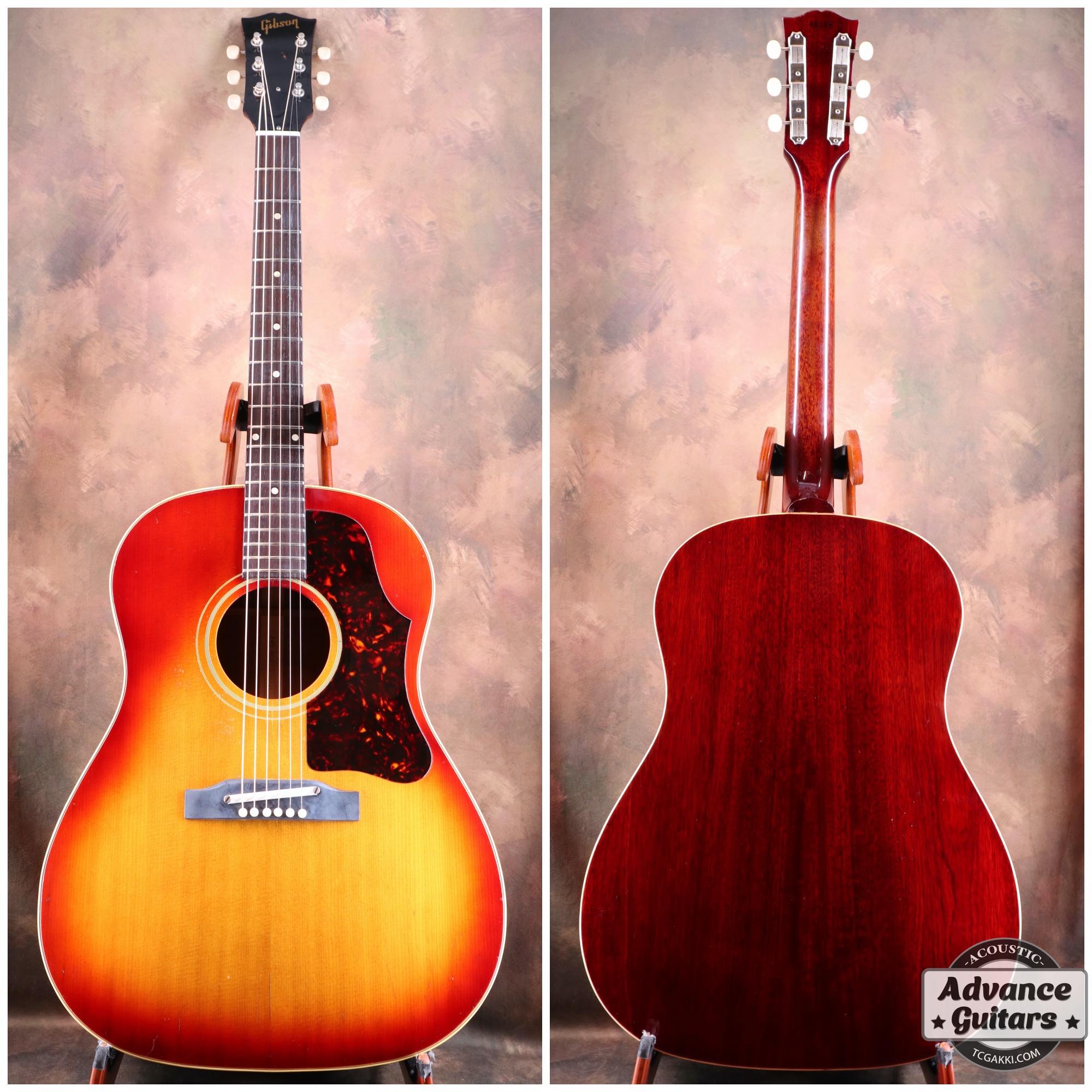
A vintage J-45 in excellent condition has arrived, featuring a stunning red and yellow top finish.
Even within the early 1960s alone, several sunburst colors existed, and this particularly reddish finish represents those from around 1961 to 1964.
The unique specifications of this era extend beyond just the finish.
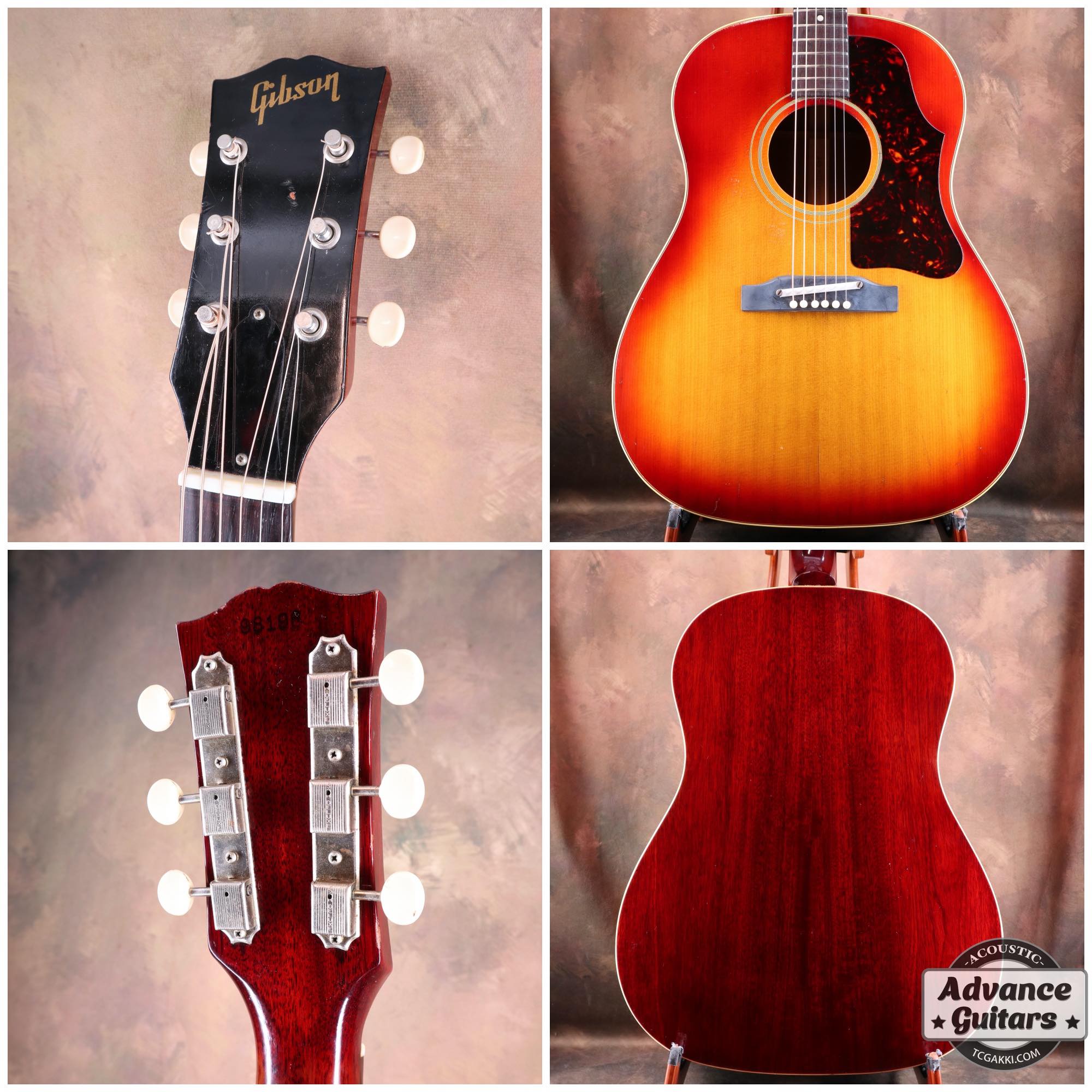
The thin, large pickguard defining this instrument's character is original and painted-in. Its reddish hue is characteristic because the underlying finish is light.
Cracks around this area are common, but remarkably, this particular guitar has no cracks around the pickguard.
This clearly shows it was cherished by its previous owners.
One of this particular instrument's most notable features is its plastic bridge. This specification was used only on J-45s from late 1962 through 1964. Beyond the J-45, this bridge was also used on models like the Hummingbird, B-25, LG-1, and LG-0. On small-body models, instruments with this bridge can be found up until around 1967.
Structurally, the bridge is secured to the body top via a bridge plate using four bolts.

The design relies on the bridge plate to bear the weight of the tensioned strings, which seems somewhat impractical. Indeed, it's common to see examples where the plastic bridge has cracked, warped, or lifted away from the body top.
From a repair perspective, this is troublesome because it cannot be machined like wood and cannot be restored to its original state. While it remains functional for playing due to the bolted connection, it is often replaced with a wooden bridge to address cosmetic concerns and prevent further damage to the body top or bridge plate.
One might wonder if any effort was made to compensate for this structural weakness. What's interesting here is the specification change to the bridge plate in 1963. Upon closer inspection, the plate, which had been a single piece until the previous year, now features a three-layer construction and is slightly larger in size. I've also seen 1963 Hummingbirds with a two-layer specification. While the correlation with the adoption of plastic bridges isn't certain, it's plausible this change was made to enhance the guitar's structural strength.


Considering the structural aspects, it's perhaps understandable to think, "Should I avoid choosing guitars with plastic bridges?"
.
It's not limited to plastic bridges, but
if you dislike the appearance or feel the playing condition is unsatisfactory, I can't forcefully recommend it.
However, among guitars equipped with plastic bridges, there are some that produce surprisingly wonderful tones.
Plastic bridges are hollow inside, so they give the impression of producing an open, airy, and beautiful sound.
They also seem well-suited for singer-songwriter styles.
Since existing examples are relatively rare, they offer the appeal of creating a sound that stands out from others.
This particular example is also in excellent condition and is one of those J-45s that produces a truly wonderful tone.
The bridge is plastic. There is only minimal lift, no significant warping or cracks, and the condition is very stable.
There are no issues with its use.


The adjustable saddle is a glossy ceramic type.
Matte saddles exist, and later models sometimes feature wood saddles,
so this part is often a key point for those seeking early-production models.
The neck is a regular neck with a 42mm nut width.
While it has a cambered profile,
it doesn't feel excessively thin and is actually on the thicker side for this period.
It features an original Delrin nut and single-line Kluson tuners on the headstock.
Considering its age, the exterior condition is exceptionally good, making this a recommended piece with collectible appeal.
[Specs/Case]
TOP : Spruce
BACK/SIDES : Mahogany
NECK : Mahogany
FINGERBOARD:Brazilian Rosewood
BRIDGE: Plastic
NUT WIDTH : 42mm
SCALE : 628mm
CASE : Non Original Hard Shell Case
※Consignment item
[Condition]
- String height at 12th fret: 6th string side 2.5mm, 1st string side 1.8mm
- Fine string height adjustment possible via adjustable saddle.
- There is a repair mark from peeling at the center joint on the body top.
[Regarding Warranty]
As this is a consignment item, our store warranty does not apply.
Of course, after purchase, we can discuss adjustments, repairs, etc. (for a fee) upon request.
Please note: This item is excluded from our mail-order trial service. (No returns accepted)
Estimate shipping
Payment & Security
Your payment information is processed securely. We do not store credit card details nor have access to your credit card information.
Warranty for Used Products
Detailed warranty terms and conditionsHerePlease see
Electric Guitar/ElectricBass/Effector/Amplifier (Adjustment Warranty: Up to 5 Years)
If your product malfunctions or stops producing sound after purchase, we will provide free service. The warranty period varies by product.
Acoustic Guitar (Peace of Mind Warranty: Up to 6 months)
We will provide free service for any malfunctions occurring during normal use within one month or six months after purchase.
Wind instruments (up to 1 year)
Upon arrival, we perform internal tube cleaning, appropriate replacement of consumables, and necessary repairs and maintenance. Should the instrument malfunction or cease to produce sound during normal use, we will address the issue free of charge.
◯Junk items come with no warranty.