
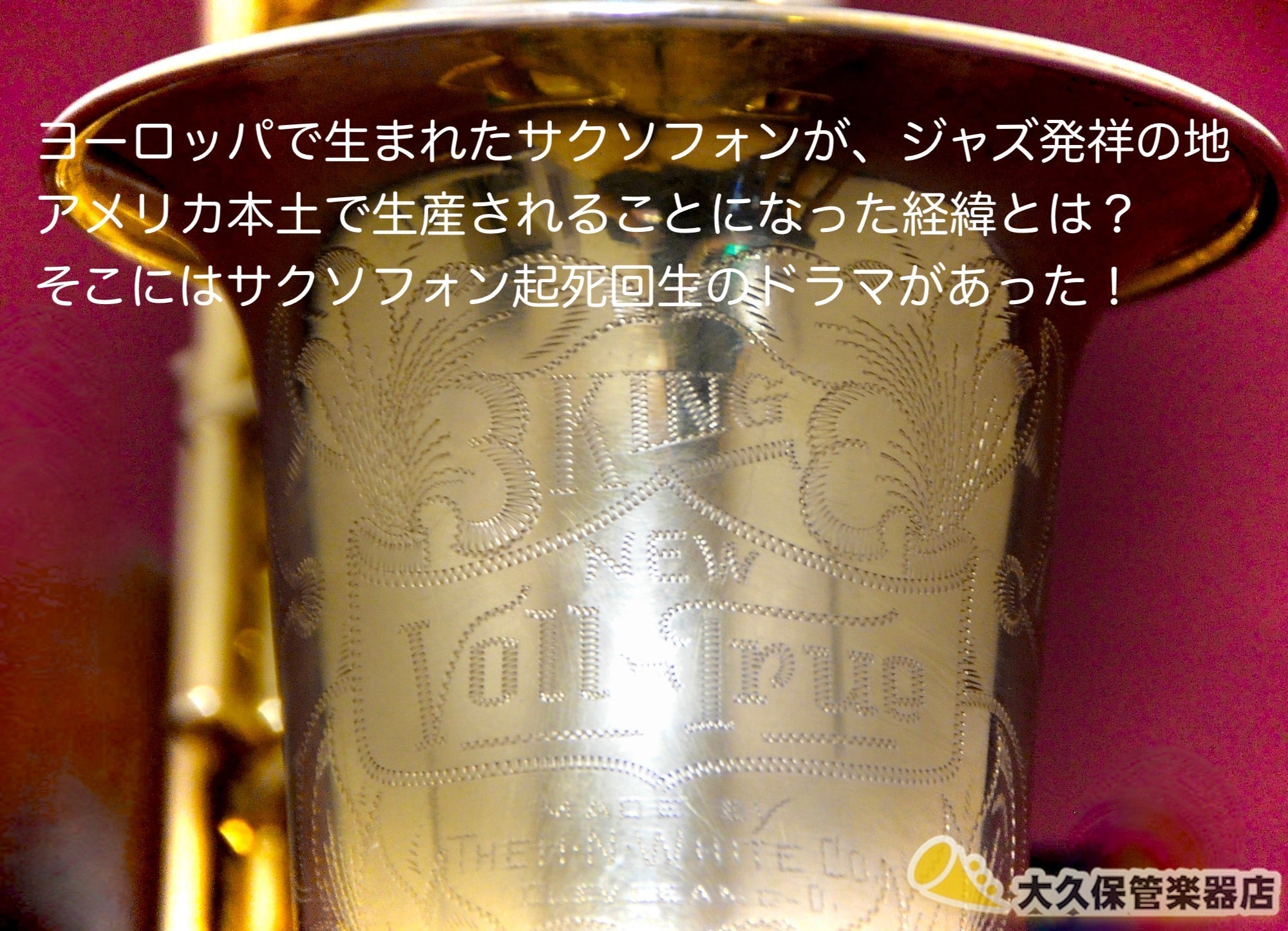
How did the saxophone, which originated in Europe, come to be manufactured in the United States—the birthplace of jazz?
It was a dramatic story of the saxophone’s remarkable comeback!

The saxophone was invented around 1840 by Adolphe Sax ( Adolphe Sax), a Belgian, around 1840. To promote the instrument, he moved to Paris in 1842. The saxophone began to be used in military bands in France and England and spread throughout Europe in the blink of an eye.
As the patent rights Adolphe had obtained expired, numerous imitations appeared, primarily from French instrument manufacturers such as CRAMPON and COUESNON. However, the style of saxophone music Adolphe himself had championed failed to gain acceptance in Europe, and as early as around 1870, the saxophone’s popularity began to wane. Amid these circumstances, the saxophone found new life across the ocean in America.
One of the key figures behind this revival was Edward A. Lefebvre (Edward A. Lefebre), who emigrated to the United States in 1872. Lefebre established a reputation as a saxophonist in New York. In addition to performing, he lobbied C.G. CONN, a major American wind instrument manufacturer, to produce saxophones to ensure a stable supply to the market.
In the 1890s, saxophone production began in earnest at C.G. CONN and at BUESCHER, a company that had split off from C.G. CONN. Thus, the purely American-made saxophone was born.

In the 1900s, the Martin Band Instrument Company (MARTIN) entered the saxophone manufacturing market, followed by the H. N. White Company (KING) in the 1910s.In the 1920s, swing jazz—played by large big bands derived from ragtime and New Orleans-style early jazz—became extremely popular, and the saxophone suddenly took center stage as the star instrument of jazz. Sensing this trend, the French company SELMER also entered the American market. This marked the beginning of an era in which manufacturers vied fiercely with one another to develop and produce saxophones.


Currently, at Kubokan, we carry a selection of American vintage saxophones, led by C.G. CONN and including BUESCHER, KING, and MARTIN.
All instruments have been fully overhauled and adjusted, so they are in perfect playing condition—not just antiques. No appointment is necessary to try them out. Just bring your own mouthpiece and reed, and you’re welcome to try them out anytime.
American vintage saxophones are known for their rich, full-bodied, and resonant tone. Why not take this opportunity to try one out?
Okubo Gakki, Mizumoto
