
It’s Oda here!
I post fun facts about electric guitars on X (Twitter), but
since I’m limited to a certain number of characters on X, I’ll be sharing more detailed facts in this update!
Knowing these things won’t necessarily make you a better guitarist, but I’d be happy if they just made you go, “Oh, really?”
(Though, learning more about guitars = liking them more = practicing more = maybe even getting better at playing. lol)
I’m writing this while thinking “Huh, I didn’t know that!” myself, so let’s say “Huh, I didn’t know that!” together!!
Part 3 covered body materials, finishes, neck plates, pickguards, and knobs.
This time, we’re covering tremolo units and patent numbers.
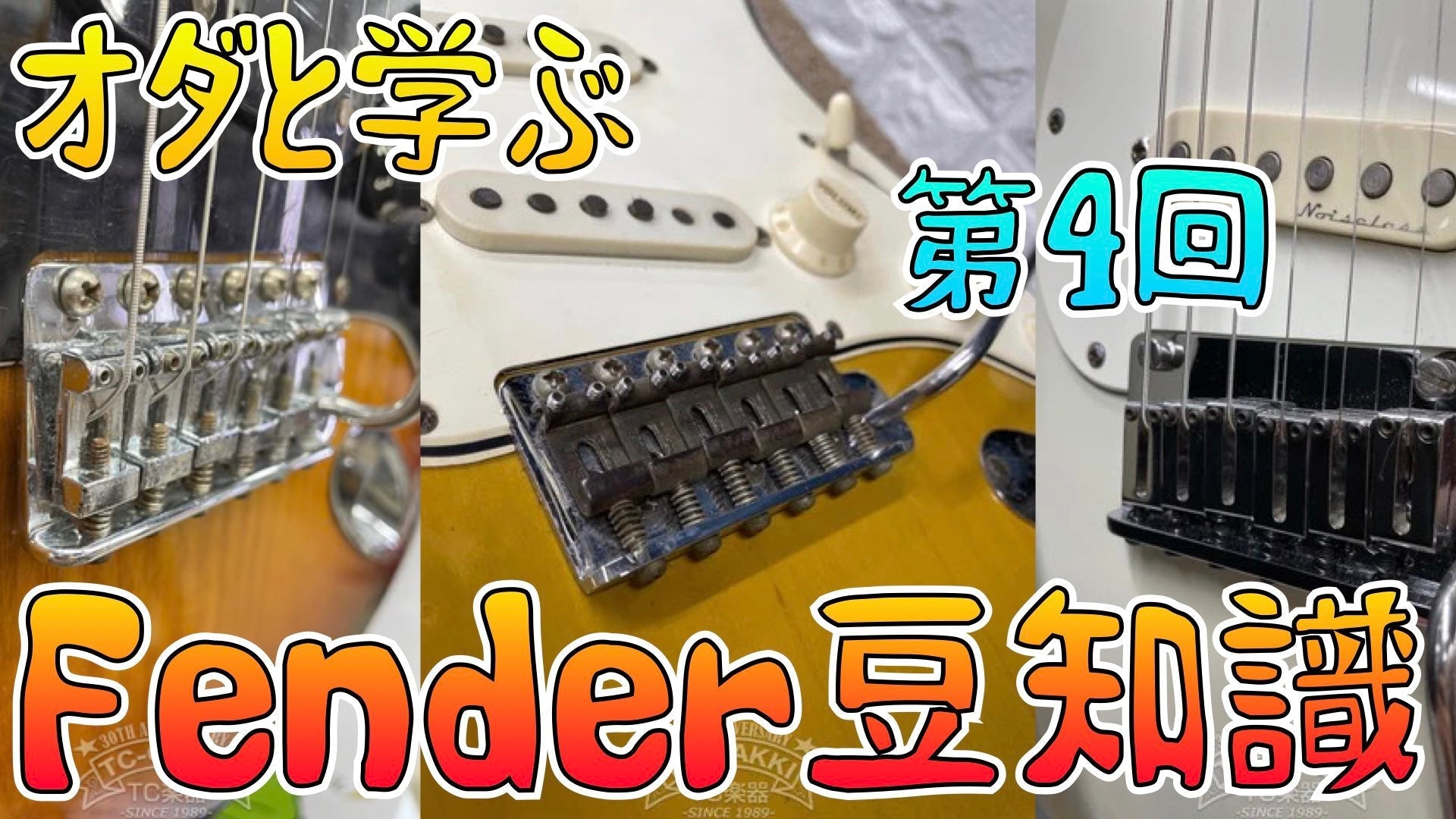
We’ve compiled information on the tremolo unit—the Stratocaster’s most distinctive feature—by era,
and traced the evolution of the patent numbers engraved on the headstock, drawing on photos of past inventory from TCGAKKI’s 35-year history!
This time, we have an announcement for everyone who’s been saying “Wow!” along with us!
We’d be thrilled if you’d read all the way to the end♪
Bridge
1950s–1960s
The synchronized tremolo unit is the defining feature of the Fender Stratocaster.
From its debut in 1954 through the 1960s, there were minor changes—such as the chamfering of screw holes, the holes in the block, and the length of the set screws—but no major alterations!
The block was made of iron. The saddles were made by press-forming sheet metal.
The bridge is the key to the sound. It’s fair to say that from the very beginning, the parts that make a Stratocaster a Stratocaster were already virtually complete!

1970s
Starting in 1972, the Inertia Block was changed from a separate cast-iron design to an integrated unit consisting of a zinc die-cast bridge plate and block. Since the saddles were also changed to die-cast at the same time, it’s fair to say that the sound character changed significantly.

Two-Point Tremolo Unit
The traditional tremolo unit we’ve discussed is a “six-point mount” attached to the body with six screws, and it remains a standard design today.
However, in recent years, some models have adopted a “two-point mount”!
The biggest advantage is the wide range of motion for the tremolo arm!
Since the tension from each string is applied at only two points, it’s also said to offer slightly better tuning stability.
The photo shows the Jeff Beck model!

Tremolo Arm
The Stratocaster tremolo arm underwent two design changes between 1954 and 1983.
From around 1954 to 1964, it was made of chrome-plated steel; from 1964 to early 1982, it was made of unplated stainless steel; and from 1982 to 1983, it returned to chrome-plated steel.
Models produced up to 1957 are characterized by a steep angle at the tip.
From the 1960s onward, most models featured a shallower curve and were nearly straight.
Even among current genuine Fender replacement parts, the Vintage Series offers both 50s-style and 60s-style tremolo arms. It may just be the angle, but it’s the angle—and I think preferences vary quite a bit on this point. 👀

Patent Number
A patent number—known as a “patent number” in Japan—is the registration number assigned when a patent is granted.
On Fender Stratocasters, the patent number is printed on the headstock, and the patent listed varies by era.
1954–Spaghetti Logo
No patent number listed

1961– Spaghetti Logo
2,573,254 Telecaster bridge and pickup assembly
2,741,146 Synchronized tremolo

1962–Spaghetti Logo
2.573.254 Telecaster Bridge and Pickup Assembly
2.741.146 Synchronized Tremolo
2.960.900 Contoured Body

Late 1964–Transition Logo
2.573.254 Telecaster Bridge and Pickup Assembly
2.741.146 Synchronized Tremolo
2.960.900 Contoured Body
3.143.028 Adjustable Neck

Mid-1965–Transition Logo
2.573.254 Telecaster Bridge and Pickup Assembly
2.741.146 Synchronized Tremolo
2.960.900 Contour Body
3.143.028 Adjustable Neck
2.817.261 Hum-Canceling Pickup
(This is a patent for a humbucker pickup used in lap steel guitars. Filed March 29, 1956.)
Unfortunately, I was unable to find a photo of this one.
1966– Transjon Logo
2,741,146 Synchronized Tremolo
3,143,028 Adjustable Neck
DES 169062 Precision Bass Shape

Late 1968– CBS Logo
2.741.146 Synchronized Tremolo
3.143.028 Adjustable Neck

Early 1971–CBS logo: “WITH SYNCHRONIZED TREMOLO” text removed
2.741.146 Synchronized Tremolo

Late 1971–CBS Logo
3.143.028 Adjustable Neck

1976– CBS Logo
The patent number was no longer listed; instead, the serial number and “Made in USA” began appearing below the logo.

What did you think?
Thank you again for watching all the way to the end.
Now, as I mentioned at the beginning, I have an announcement!
We’ve been releasing “Learn with Oda♪ Fender Trivia” over the past four episodes,
and we’ve finally completed a compilation of episodes 1 through 4!!
Since it’s a compilation, it’s really long! (lol)
We’ve reshot all the photos and organized everything to make it easier to follow, so I’d be thrilled if you could check it out!
Learn with Oda♪ Fender Trivia: Episodes 1–4 Compilation

I also post daily on X (formerly Twitter), so please follow me♪
Oda