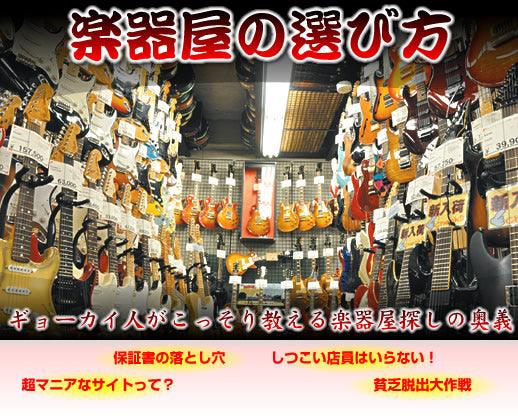
What exactly is a music store? Of course, it’s a place that sells musical instruments. But take a fish market, for example—you might hear people say, “The fish at that shop are really fresh!” or “This shop has a great selection of sashimi.” It’s the same with music stores. Each store has its strengths and weaknesses, and their product lineups vary.
Plus, a music store isn’t just about “buying and being done.” There’s maintenance afterward, and it’s common to have a long-term relationship with the store—whether you’re seeking advice when you’re having trouble with the sound or trading in an instrument when you’re ready to buy a new one. Since this can even influence your future musical journey, choosing the right store is crucial. That’s why it’s a bit risky to choose based solely on the price at the time of purchase. A top-notch musician looks at the big picture and chooses a “reliable music store.”


That’s true. It’s convenient for comparing different options. Plus, shops with a large inventory have staff who’ve seen a wide variety of instruments, so they’re often better able to recommend something that suits you. Also, the fact that so many instruments are gathered there is proof of high trust from manufacturers and customers. “Good instruments gather at good shops”—that’s the golden rule.


That’s true. But how do you gauge a salesperson’s knowledge? Ask them a difficult question? But they might just happen to know the answer. Plus, everyone has their own areas of expertise, so no matter how much knowledge they have outside your specific field of interest, it’s useless to you. It’d just be annoying to be lectured at length about things you don’t care about. So! Try observing stores that carry a wide selection of the type of instrument you’re interested in.At music stores, the staff’s hobbies and areas of expertise are often reflected in the inventory, so shops with a strong selection in a particular genre tend to have deep knowledge of that genre. However, be wary of salespeople who go on and on about things you didn’t even ask about—they’re often just showing off. A quiet person might actually be the one who’s more attentive to your needs. “Judge a salesperson’s knowledge by the selection”—that’s the second ironclad rule.


Imagine this: the instrument you worked so hard to buy won’t make a sound when you need it most!… That’s why you need a store that provides reliable after-sales service. If you’re thinking, “It’s covered by the manufacturer’s warranty, so I’ll be fine,” you’re being naive! Picture this: a sudden problem right before a live performance. You rush to the music store in a panic, only to be told, “We’ll have to send it to the manufacturer, so it’ll take one to two weeks.” Even if they fix it for free, that’s just not acceptable. A warranty promises free repairs, but it doesn’t say anything about “fixing it right away.”However, instruments can suddenly stop producing sound, and when you’re eager to practice, you can’t afford to leave it there for that long. So, when you visit a music store, check to see if they have a dedicated repair section or repair room. If the store has its own repair facilities, you might even find that “they fixed it while I was out for a smoke.” “Judge after-sales service by the equipment”—that’s the third golden rule. If the store offers its own warranty, that’s even more reassuring.


When you buy an instrument, you’ll also need various accessories like cables and straps. Strings, picks, and batteries are consumables, too. So naturally, you’ll end up visiting the music store many times—but ideally, it’s best to stick with the store where you originally bought your instrument. You can ask them how to adjust your instrument and get advice on various topics, and the appeal is that it’s easy to get useful information. Therefore, considering that you’ll be visiting repeatedly, you should find out in advance the prices of the consumables you’ll likely be buying on a regular basis.“True affordability is revealed in the accessories”—this is the fourth golden rule. Another thing to watch out for, surprisingly, are “value sets” that include “XX items.” Sure, they seem like a good deal, but do they include things you don’t need? Instructional DVDs you don’t like won’t help you practice. You need to figure out if they’re really necessary.


There are still more tips on how to choose a music store. I asked 100 band members. “Cheaper is better”—definitely. “Close to the station”—that might be true too. “A place that doesn’t feel intimidating”—aren’t you the one who’s intimidating? Still, a place where the staff is polite does give you a sense of reassurance, doesn’t it?Also, places that aren’t pushy. “A place with good restaurants nearby”—huh? Is that so? But it’s true—if there are lots of places that look delicious in the neighborhood, it gives you more reasons to go back. “A place where the staff are cute”—in the end, that might actually be the most important factor (lol). Since there are so many factors to consider, “Choose a good music store based on your personal preferences”—that’s the final golden rule.

When you’re on a tight budget, your eyes naturally turn to used instruments. Of course, it’s nice to save money, and there’s plenty of fun in the search—you might even stumble upon an unexpected gem. On the other hand, there are stories of people regretting their used purchases, so there’s definitely some anxiety involved. So, let’s do a thorough comparison of the appeal of New versus used instruments.

You might think, “Well, new ones are obviously better,” but hold on a second. These days, instruments from reputable used shops are in remarkably good condition. Since used shops don’t have manufacturer support, they have to adjust almost everything in-house. That’s why quite a few of them employ specialized technical staff. On the other hand, with new instruments, shops usually just display the items as they come from the manufacturer, and if a problem arises, they send them back to the manufacturer for adjustments.Back in the day, you’d see plenty of really terrible used instruments, but lately—perhaps because the quality of used shops has improved—there are more and more used instruments in truly excellent condition. Well, auctions might be a different story, though. So when it comes to condition, I’d say it’s pretty much a toss-up these days. The rest really depends on the shop!


Needless to say, it’s reassuring to have one, but as I’ve mentioned before, a warranty isn’t a magic bullet. So, focus on whether the after-sales service meets your needs. For example, when it comes to repairs involving the circuitry of an electric guitar, a repair technician at a used music store can often handle it just fine, so speed might be more important.With a manufacturer’s warranty, the instrument has to be sent back to the manufacturer, so retailers might not get involved—whether they can check it right there on the spot is a major factor. On the other hand, when it comes to software updates for DTM equipment, they’re often managed with IDs and passwords, so used items are often out of the question; in this regard, buying new with a warranty is definitely the better option.

“Is it broken?” “Will it break right away?”

It’s certainly a cause for concern. And it’s true that some used items are actually broken. But conversely, it’s also true that New items aren’t guaranteed never to break right away. In other words, whether something breaks or not isn’t a matter of whether it’s new or used. Furthermore, with used items, some have a proven track record of working without issues up until now, so if you have a good eye for them, you can predict their future performance to some extent—more so than with a New item, which is a complete unknown.Well, since it’s pretty hard to judge that level of detail, it’s still important to choose a store you can trust. Ultimately, the issue isn’t whether it’s New or used—it’s whether you’re buying from a trustworthy store.


“I fell in love with a rare color at first sight, bought it used, and now everyone’s jealous.”
This happens all the time with used items. Even people who’ve been dealing in used goods for years are sometimes surprised to find something and exclaim, “Did this color even exist!?” And it’s not just about the color—you’re way more likely to come across something truly rare! The fact that you can’t find it anywhere else is a big plus, too. Plus, it’s fun because these kinds of items are often surprisingly affordable when bought used.
“It’s great that I can just go all out with it without worrying about things like eating pizza!”
Whether pizza, beer, and instruments are the stars of the party or not, you can’t really enjoy yourself if you’re constantly worried about getting them dirty or scratched. The fun of buying used gear is being able to use it without worry—and adding your own “memorable” scratches to an instrument that already has some. When I spilled beer all over my Les Paul the very day I bought it, I thought from the bottom of my heart, “I’m so glad I bought this used…”


You might think secondhand shops are intimidating at first, but once you step inside, it’s like a treasure hunt! It’s so much fun that you’ll lose track of time…That Effector you always wanted back in the day, or that guitar a friend had back in middle school—you might find yourself taking an unintentional trip down memory lane. Since every used item is one-of-a-kind, each one has its own story. Plus, well-worn instruments are just cool! These days, there are even New instruments being released with intentional scratches. But when it comes to scratches, nothing beats the real deal—used gear. Natural scratches are the coolest.
Once you’ve had a good look around and enjoyed yourself, try striking up a conversation with the staff. At used gear shops, the staff can sometimes seem older and a bit unfriendly, making it hard to approach them, but ultimately, they’re doing this because they love it—and there are actually a lot of great people there. Plus, since they’re identifying this many used items every day, their knowledge can be absolutely incredible. You could say the staff are veterans in their own right. When you happen to hear some truly insightful advice, it feels like you’ve hit the jackpot just from that alone.

Things have really become convenient these days. Since each used item is one-of-a-kind, finding the right one often comes down to timing—but now you can even check for those opportunities online. It’s an amazing era we live in. One site you definitely need to check out is the website for “THE Used Musical Instrument Store,” located in front of Shin-Okubo Station on the JR Yamanote Line.
With a massive inventory of over several thousand items updated daily as soon as they come in, just browsing this site alone will lead to plenty of great finds. What’s more, you can see not only detailed photos of every angle—from front to back—but even real-life videos, which is amazing! It really feels like you’re looking at the actual item. It’s perfect for you if you’re too busy to go out and hunt for instruments.Another amazing feature is their column section. This is seriously awesome! It’s packed with a massive amount of information—about guitars, Effectors, and more—shared without holding anything back. It’s a true enthusiast’s paradise! Just reading this will give you a leg up on your rivals! At the same time, their beginner-friendly series is easy to understand and well worth reading. If you’re already familiar with it, you’re seriously cool!


“I found a cool used guitar, but I just don’t have the cash…” I totally get it. Being in a band really costs a lot—between studio fees and travel expenses. Band members are amazing—they’re often barely scraping by just to make ends meet, let alone buy instruments. THE Used Music Store is on your side. We all love instruments—we’re in this together. So if you’re thinking, “I want that instrument, but I don’t have the money…,” feel free to reach out.They’ll give you all kinds of helpful advice, like how to trade in your current instrument to get a discount. We have specialized staff who inspect thousands of used items every year—from guitars, of course, to amps, PA systems, wind instruments, and even violins—so no matter what you have, they’ve got you covered.
Even if an item is old and you’re wondering, “Will this even be worth anything?,” they’ll take a proper look at it with a professional eye. After all, everyone here loves instruments, too. If you have any unused instruments or gear lying around, go ahead and ask them about it. And even if you don’t have any immediate plans to buy an instrument, this shop can still be a big help. If you’re not trading it in, they’ll even buy it from you for cash. It’s great that they pay you right there on the spot.It’s a lifesaver when you have a last-minute gig and you’re wondering, “Will I make my quota?” Plus, Shin-Okubo is the heart of Asian cuisine. There are tons of cheap and super-delicious restaurants, so it’s a great idea to grab a bite to fuel up while you’re there.
So, let’s check out the gear you have on hand.
Aren’t there still some hidden treasures lying around your room?
For items like amplifiers that are too big to bring in right away, just send a photo, and they’ll email you an offer.