
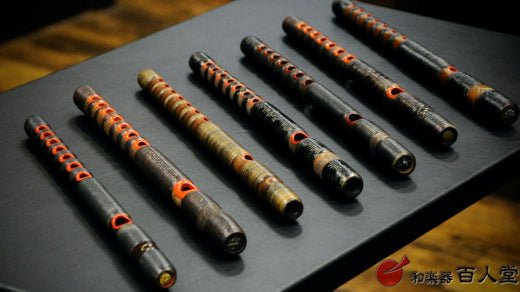
We offer Noh flutes from every era, ranging from antique instruments from the Edo period to new ones crafted by Showa-era flute makers.
If you visit our store, you can try playing the flutes.
Each Noh flute is unique, with its own distinct tone and playing feel.
Please take this opportunity to experience the true essence of the Noh flute.
*All of our Noh flutes have been fully serviced by a flute master.
[What is a Noh Flute?]
A flute unique to Japan, used in the musical accompaniment for Noh, Kabuki, Nagauta, festivals, and other events. It does not feature Western-style melodies but is played rhythmically and powerfully, following the melodic patterns based on “shoga” (※).
(※) Shōga… A musical notation system in which the sound is transcribed using katakana, such as “Ohiyara-arihiuiya, Hi-u-rorora-a-.” While Nohkan shōga involves variations in pitch, it is not an absolute melody but rather resembles a rhythmic phrasing that emphasizes nuance. However, the meter (rhythm) is strictly defined.
Total length: approximately 39 centimeters. Outer diameter: approximately 3 centimeters.It is made of bamboo. The head section—from the tip to the mouthpiece—is often crafted from “male bamboo” (such as madake), which has thick nodes, and is joined to “female bamboo” (shinotake), which has thin nodes. Seven finger holes are arranged in a straight line.
Although the Nohkan has varying pitches, its mid-range is narrower than a standard scale, creating a unique transition between notes.Because the sound is overlaid with the breath noise (noise) produced while playing, in addition to the pure musical tones, the overtones are significantly amplified. These elements combine to create a unique timbre that instantly transforms the atmosphere on stage the moment the instrument begins to sound. The high-pitched, shrill sound characteristic of the Nohkan—known as “hishigi”—contains high-frequency tones that exceed the human audible range, lending it a rare power not found in other flutes.
The Nohkan is also known as the “flute that summons the gods,” and it is said that its roots lie in the stone flutes (iwabue) used in rituals during the Jōmon period.
On the Noh stage, the Nohkan’s “hishigi” is played to summon entities not of this world—such as gods and the deceased—onto the stage.
This is precisely why it is considered a direct descendant of the stone flute.
The Nohkan is a robustly crafted, highly durable flute that develops a richer resonance the more it is played. It is said to reach its full potential one hundred years after its creation, and it is not uncommon for the flutes used by performers on stage to be over three hundred years old.
*Since it is susceptible to drying out, careful storage and regular playing are essential to maintaining it in good condition.
From antique Noh flutes from the Edo period to modern ones from the Showa era, there is a wide variety of Noh flutes, each with its own unique character.
Tags: 管楽器