
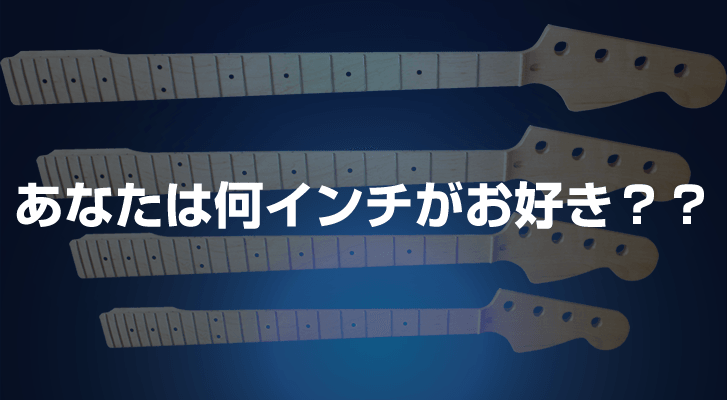

Even though we simply call it the neck “scale,” there are actually necks of various lengths. I often hear people ask, “What kinds of Bass scales are there?” Here, I’d like to highlight and introduce four representative Bass scales—plus a few others♪
◎ Long Scale (approx. 864 mm / 34 inches)

This is the classic Bass scale—so much so that when you say “Bass scale,” this is what comes to mind!!


Starting with standard Jazz Basses and Precision Basses, most Basses are built with the long scale as the foundation. There are certain qualities that can only be achieved with a long scale—the string tension and sound are more defined, giving the tone a crisp, lively quality. Incidentally, getting into the finer details, even though they’re all called “long scale,” there are slight differences in length depending on the manufacturer—for example, Rickenbacker is about 845 mm (33 1/4 inches), while Gibson is about 870 mm (34 1/4 inches).
◎ Short Scale (762 mm / 30 inches)

・Fender Mustang, Gibson EB, ALEMBIC, Hofner Violin Bass, FERNANDES PIE-ZO, Pignose…etc

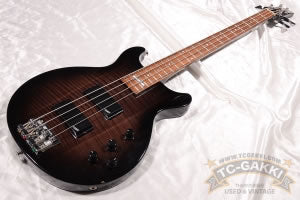
Because the scale is shorter, string tension is slightly lower, which can result in a weak, muddy bass sound or unstable tuning. However, a shorter scale also means the fret spacing is narrower, making finger movement (shifting between frets) easier and improving playability—these are unique advantages of the short scale!! It’s recommended for Bassists and vocalists, as well as guitarists recording at home, and is especially suitable for women and children♪
Jack Bruce (Cream), Andy Fraser (Free), Stanley Clarke, Bill Wyman (The Rolling Stones), Gene Simmons (KISS), TAIJI (X JAPAN), ROY (THE BAWDIES), Seiichi Iida, Seiji Kameda…etc
◎ Medium Scale (814 mm / 32 inches)

・YAMAHA MOTION B, Fender Japan JB62M, ALEMBIC…etc


This scale falls between the long and short scales. Many technical bassists prefer this scale because the fret spacing feels narrower than on a long-scale neck, prioritizing ease of movement. While it helps produce a thicker low-end and somewhat mitigates the drawbacks of a short-scale neck, it may still feel a bit lacking compared to a long-scale neck. However, just like the short-scale neck, the shorter scale length makes finger movement (moving between frets) easier and improves playability—these are definite advantages!! Nowadays, this scale is even starting to be adopted in basses designed for beginners, so it’s becoming a more viable option for a first instrument. Just like the short scale, it’s recommended for women, children, and guitarists recording at home♪
Stanley Clarke, TAIJI (X JAPAN), Yuko Oshima (AKB48)…etc
◎ Super Long Scale (889 mm / 35 inches, 914 mm / 36 inches)


・Fodera, Elrick, Lakland, MTD, Tune, ESP AP/SL, Yamaha TRB…etc


Longer than the standard 34-inch long scale, it is also referred to as an “extra-long scale.” In recent years, it has been particularly popular for 5-string and 6-string basses, as well as basses designed primarily for down-tuning.
Anthony Jackson, Ikuo, tetsuya,
< Bonus Section ~ There Are Scales Like These, Too!! ~ >
・Fretless

・Dingwall, Strandberg, Ibanez…etc

Fundfret—commonly known as “Fanfret”—features frets on the fingerboard set at an angle in a fan shape and adjusted to the required scale length based on the gauge of each string (1st–4th). This design achieves optimal tension for each individual string and produces a clear, uniform tone. Although lengths vary by manufacturer, they typically range from approximately 35.5 inches on the bass side to approximately 34.0”–33.6” on the treble side. In recent years, an increasing number of manufacturers have been actively developing fan-fret guitars.
Lee Sklar (Lee Sklar), Adam Getgood (Periphery)
・33 inches

・STR, TUNE, Phoenix, Bacchus…etc


Set to 33 inches—1 inch shorter than the standard 34-inch long scale. It’s longer than a medium scale, and one of the charms of this scale is that it can be played with a light touch♪
・34.5 inches

F-bass, dragonfly, Wyn…etc


A 34.5-inch scale, which is slightly longer than the standard 34-inch long scale. It strikes a balance between tension on the low strings and playability, offering a clear tone and overall balance. This scale is primarily used on 5-string Basses and similar instruments.
Marcus Miller, Alan Caron, KING (formerly of SHAKALABBITS)…etc
・Baritone Scale

・Fender BASS VI, Danelectro Longhorn Baritone, Musician Silhouette Bass…etc


The baritone guitar/bass sits between a guitar and a bass. While there doesn’t seem to be a clear definition, it generally has a scale length of approximately 27–8 to 30 inches. It is used by bassists and guitarists across various genres, including rock, surf, and heavy metal. It is an indispensable instrument in the history of music and musical instruments.
Tetsuya (L’Arc~en~Ciel), John Lennon (The Beatles), Joe Perry (Aerosmith)…etc
[In Closing…]
While the scale length affects the sound, string tension, and the Bass’s design… the bottom line is, if you like the way it feels when you play it, that’s all that matters!!!
Just as every player is unique, so is every instrument. I recommend trying out different scales and choosing the one you like best!!