

When it comes to guitar amps following Marshall and Fender, what comes to mind? Most people would probably mention Mesa/Boogie.As another iconic representative of American amplifiers, it’s a long-established brand that has shaped the sound of its era. With the MK series—whose first-class tone has been loved across genres, from Santana to Metallica—and the Rectifier series, which has even come to define the modern heavy sound, it stands as one of America’s leading brands, known for its highly original, high-quality sound and an unwavering commitment to uncompromising design and manufacturing principles.Through its uncompromising dedication to playability and sound quality—such as the design of its power amplifiers featuring a unique output structure known as “SimulClass”—the brand has produced numerous one-of-a-kind models.Marshall was also a pioneer in producing two-channel models with switchable clean and drive modes—a feat said to be a world first. In this article, I’ll trace the history of how Mesa/Boogie came to be known worldwide, focusing particularly on the early MK series to examine the uniqueness of its design.
It All Began with the Fender Princeton
Randall Smith, the founder of Mesa/Boogie and the designer of Mesa/Boogie amplifiers, began repairing and modifying amplifiers in the late 1960s. Born in San Francisco in the 1940s to a father who was a clarinetist, he had been familiar with the sounds of musical instruments—especially woodwinds—since childhood.Furthermore, from his boyhood, he was fascinated by vacuum tube audio circuits—which were cutting-edge at the time—and reportedly spent a lot of time at a garage shop run by a local engineer, where he enjoyed building radios and other devices. In this way, Randall Smith grew up surrounded by the sounds of high-quality instruments and excellent engineering.

Then, in the 1960s—the heyday of rock ’n’ roll—Fender had already become a central force in American music with its Blackface amplifiers, while across the ocean in the UK, Marshall amplifiers were just beginning to emerge. However, in the music scene of that era, the electric guitar was still primarily relegated to the rhythm section, and most of the solo parts between verses were filled by wind instruments such as the saxophone.It was during this era that many guitarists, while hoping to take center stage with lead playing, struggled with a lack of the sufficient gain and sustain required to do so.While Fender amplifiers—the mainstream choice at the time—performed exceptionally well for chord work, it was quite difficult to achieve the smooth, singing tone characteristic of wind instruments; moreover, Marshall amps had not yet gained widespread popularity in the United States. As a result, modifications such as adding a master volume control to Fender amps were attempted, but the situation persisted where it remained difficult to achieve a high-quality lead tone.
Amid this scene, high school student Randall Smith naturally became obsessed with rock ’n’ roll. Although he played drums (coincidentally, just like Jim Marshall), he apparently already possessed considerable engineering skills by this time and was even repairing his bandmates’ amps.Eventually, his repair skills became widely known, and he established a repair shop in the San Francisco Bay Area with a friend. His shop became a major local sensation, and many musicians—including Jefferson Airplane and the Doobie Brothers—began to drop by.
During those days, he was primarily repairing and modifying Fender amplifiers, but one day in 1969, on a whim—thinking, “It would be funny if a small practice amp could produce an incredibly loud sound”—he installed a large transformer into a Fender Princeton amp and incorporated a Bassman circuit with two 6L6 power tubes.He replaced the baffle board and installed a 12-inch JBL speaker (reportedly, he used the original baffle board he removed as the door to his workshop, which was called “Dog Yard” at the time). A customer who happened to be passing by played it and said, “Shit, man, that little thing really boogies!!” This became the origin of the name “Boogie.” That customer was Carlos Santana, who was taking the music world by storm at the time.
Thanks to Santana, this Boogie/Princeton attracted a great deal of attention, and a huge number of orders reportedly flooded in to Randall.As a result, he built about 150 to 200 of these Boogie/Princeton amps, but since they were based on old Fender amps, supply couldn’t keep up, and it became difficult to meet the ever-increasing demand. Consequently, Randall founded a company called Mesa Engineering and began developing and manufacturing original amplifiers.(That said, Mesa was actually a name Randall needed for his side job repairing cars—he was incredibly handy—and he reportedly just came up with it on the spot…) In any case, the first model of his original amp was produced under the name “Mesa/Boogie” (perhaps with a similar nuance to “Sony/Walkman”), and about 3,000 units were manufactured. This is what would later be known as the MK-I.
The First Lead Guitar Amp?
The MK-I made its debut in 1972. By adding one more preamp tube to the Princeton/Boogie model, it became possible to achieve even more gain and sustain.With three volume controls—Volume 1, Volume 2, and Master—it offered a wide range of gain control. It’s said to be the world’s first model equipped with a dedicated volume control for boosting gain. Considering that even Marshall didn’t introduce models with a master volume until 1975, it’s not hard to imagine just how early this innovation was.Furthermore, the enclosure housing the 12-inch speaker was crafted from premium hardwoods such as corewood and maple, giving the amp a sophisticated, high-end instrument-like presence unlike any guitar amp that had come before. Perhaps the singing tone and rich resonance of the wood reminded Randall of the sound of the clarinet, an instrument he had been familiar with since childhood.Needless to say, this was the heyday of Carlos Santana; coupled with the rise of hard rock and the crossover movement, the music scene was shifting toward one where lead guitar increasingly occupied a central position. In Japan as well, many lead guitarists—such as Masayoshi Takakou—were captivated by this model’s expansive tone, helping it establish a global reputation.


Note: Production of the MK-I reissue model ended at the end of August 2008.
Then, in 1979, the MK-II—featuring a lead/rhythm switch—made its debut. (Conversely, with the introduction of the MK-II, earlier Mesa/Boogie models came to be referred to as the MK-I.) The channel-switching feature at that time was groundbreaking, coming at a time when neither Marshall nor Fender had yet implemented it.From a global perspective, it’s debatable whether this or Japan’s Yamaha F Series came first, but it’s safe to say this was likely the world’s first tube amplifier to feature this technology.Then, in 1980, the MK-IIB was introduced, featuring the world’s first effects loop and Simul-Class technology. This proprietary operating system successfully blended Class A and Class AB operation of the power tubes to bring out the best of both, enabling a high-output yet delicate and responsive “bell-like tone.” This feature became a Mesa/Boogie-exclusive patent and has been used in the MK series to this day.Then, in 1983, the MK-IIC was introduced, featuring a switchable effects loop. While Mesa/Boogie is often perceived as a brand more closely associated with later eras compared to Marshall or Fender, it’s clear that—despite a slightly later start—the company was an extremely forward-thinking manufacturer, consistently developing features that would later become the foundation of the industry, well ahead of other brands.This MK-II model, with its high-gain tone that seemed to anticipate the times, was not only highly valued by fusion players but also favored by the heavy music scene, including bands like Metallica; it can be said that it laid the foundation for the equation “high gain = Boogie.”In fact, in the heavy metal scene that emerged in the mid-1980s, modified Marshalls or stacks of MK-III cabinets with wire mesh cabinets became a trademark look.


Let’s take a quick break—we often hear terms like “Class A” and “Class AB,” but what do they mean?
You often see these terms in amp specifications, but what do they actually mean? They refer to the operating state of the power tubes. Power tubes are vacuum tubes responsible for amplifying the signal from the preamp to a level loud enough to drive the speakers, but there are various factors involved in ensuring stable operation, and their operating conditions can vary.
To explain this simply with a diagram: since an audio signal is a waveform, it looks like the one shown below.

“Class A” refers to an operating mode in which all tubes are constantly active and amplifying this signal (regardless of whether an input is present). Since each tube is always operating at full power—even before an input signal arrives—the response to the input signal is excellent, resulting in a rich, expressive tone that sensitively captures nuances of touch.On the other hand, because the tubes are constantly operating at full power, they generate a significant amount of heat and clip quickly, making this configuration unsuitable for high output levels. For the same reason, another drawback is that the tubes have a short lifespan.
To address these issues, the Class B operating mode was devised. First, the waveform shown in the figure above is divided into two halves from the center.

This results in a shape like the one shown here. If multiple tubes are used—with one tube amplifying the upper half of the waveform and the other amplifying the lower half—the workload on each tube is reduced by half. This mode of operation is called push-pull.Furthermore, unlike Class A, which was in a fully driven state even before a signal was input, Class B introduces a bias current when a signal is input, allowing the tubes to remain idle when no signal is present—a feature that significantly extends their lifespan.
However, Class B had drawbacks such as poor response due to the tubes taking time to warm up after a signal is input, poor reproduction of small signals (though this was less of an issue at high volumes), and noise, making it unsuitable for audio applications. Class AB was developed to address these issues by applying a small bias current to the push-pull circuit as needed, thereby improving response.It can be said that Class AB gives Class B a slight Class A-like function, and most amplifiers—such as Marshall and recent Fender models—utilize this configuration.
The “Simul-Class” technology introduced in Mesa/Boogie’s MK series successfully blends the best of both worlds—the responsive tone of Class A and the high-power output of Class AB—by having two of the four power tubes operate in Class AB at 60W, while the other two operate in Class A at 15W, and mixing the outputs.For the power tubes operating in Class A mode, you can swap out the standard 6L6 tubes for EL34s, allowing you to choose a sound with a slightly more European character.
Naturally, as mentioned earlier, the maximum output and tube lifespan are not as high as in Class AB mode. For this reason, 60/100W models operating in Class AB mode are also manufactured.
*Regarding Class A*
In the world of audio, there is some debate over exactly what constitutes “pure Class A” operation, and some argue that amplifiers operating in strictly Class A are virtually nonexistent. However, the term “Class A” as used here refers to what is commonly called Class A in the guitar amplifier world, and includes cases such as “Class AB that is as close to Class A as possible” or “Class AB with a Class A-like character.”
MK-III to MK-IV
Let’s return to the history of the MK series. In 1986, the MK-III—which would become the most iconic model in the series—was introduced. This model featured a three-channel configuration: in addition to the conventional Lead and Rhythm channels, it included a “Rhythm 2” channel that featured a clipped version of the Rhythm channel. At a time when even two-channel switching was still a novelty, this model was considered far too avant-garde.The standard configuration was 60W with two 6L6 tubes, but options included a Simul-Class configuration using four power tubes and 60W/100W models. Foot-switchable EQ and reverb were also available as options.While a traditional hardwood cabinet was available, the EX cabinet—with its black metal grille—projected a rugged, hard-edged image, and alongside Marshall, it became an iconic presence in the hard rock scene of the 1980s.
|
|
|
|
|
|
|
|
|
|
|
|
| Then, in 1989, the MK-IV with its independent three-channel configuration was introduced. It featured six-way footswitches that allowed users to toggle between three independent channels—clean, crunch, and lead—as well as EQ and the effects loop; it could also be controlled externally via other switchers.In addition to the familiar Class A/Simul switch, it also offered Triode/Pentode selection and even included a recording output capable of muting the power amp—truly a model with every feature imaginable. While these features are mainstream today, it’s astonishing to consider how forward-thinking it was to include them nearly 20 years ago. The MK-IV is still in production today and can be purchased new. Update: Production of the MK-IV ended at the end of August 2008. |
|
|
|
|
|
|
|
|
|
|
|
|
|
|


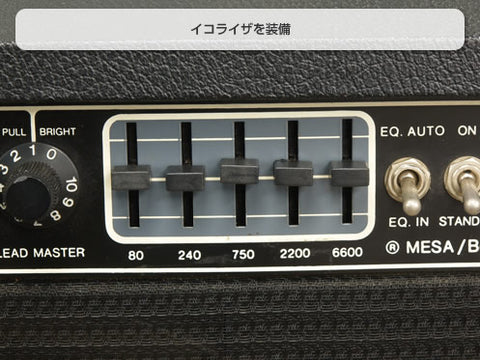


So, we’ve taken a quick look at the evolution of Fender’s modified Princeton and Boogie models all the way up to the MK-IV. But I imagine the model you’ve seen most often in studios and elsewhere is, after all, the MK-III.I imagine many of you have played an MK-III at some point. When talking to such people, I occasionally hear comments like, “The MK-III has great distortion, but the clean tone is…” In fact, I used to think that way myself for a while. However, I once had the opportunity to play a New MK-III—one equipped with new American tubes—and the impact was so striking that it ranks among my “top three clean tones I’ve ever heard.”(The other two are the Callaham EL84V and the Fender Tweed Twin.) The harmonics sounded beautiful and three-dimensional, coming from every direction, and I realized, “So this is what that ‘bell-like’ sound is all about”—the afterglow of that experience is still etched in my memory.
For the reasons I’ve explained here, the Mesa/Boogie MK series is specifically designed to reproduce the tone of vacuum tubes more faithfully, which is why the sound is exceptional when high-quality tubes are used. However, for the same reason, the tubes wear out faster than in other models, so not all units are in perfect condition.Because they are more faithful to the sound of the tubes, they have the honesty to reproduce that sound exactly as it is even with worn-out tubes—and it feels like a bit of a shame that this aspect makes the MK Series’ reputation somewhat mixed. (To put it bluntly, a Marshall, for example, has the tenacity to produce the “Marshall sound” even with mediocre tubes, and I think that’s part of what makes Marshall so impressive…)
If you own an MK series amp and have concerns about the clean tone, I highly recommend trying to replace the power tubes. Also, if you happen to see one in a studio or elsewhere, take a look at the back—the sound differs significantly depending on whether it’s a 60W, 60/100W, or Simul Class (marked “Simul Class” on the back)—so checking the back panel can be quite interesting.

I’d also love to hear your feedback regarding this “Amp Wanderings” series—whether you have requests or ideas for topics you’d like me to cover. I’m still learning, but I’ll do my best to respond to your suggestions within my capabilities (and expand on them as I go).
